3 min readChatGPT shopping
How ChatGPT Instant Checkout Works for Shopify Brands (and Who Owns the Customer)

By Kratik Agrawal
Published Jun 11, 2026 Updated Aug 5, 2026
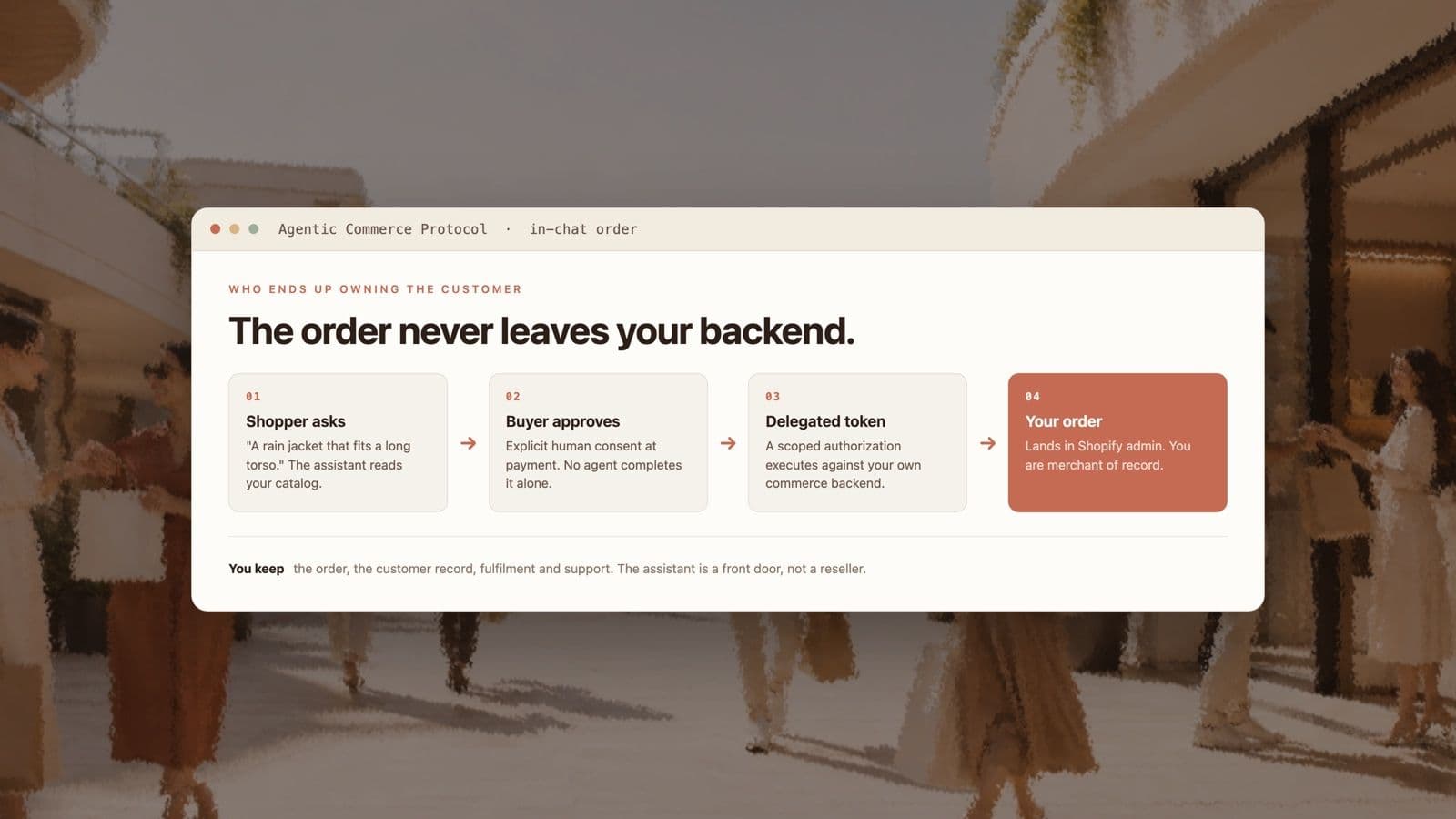
A shopper asks ChatGPT for a rain jacket that fits a long torso, gets three options, taps buy, and never sees your site. The order lands in your Shopify admin a few seconds later with your name on it.
That path is live for Shopify merchants now, which turns it into a distribution decision rather than a thought experiment. The mechanics decide who ends up owning the customer, so they are worth reading closely.
Quick answer
ChatGPT Instant Checkout lets a shopper complete a purchase inside the conversation. It runs on the Agentic Commerce Protocol, an open spec OpenAI developed with Stripe, and executes the order against the merchant's own commerce backend. The brand stays merchant of record: the order, the customer record, the fulfilment and the support relationship all remain with the store.
How Instant Checkout actually executes an order
Instant Checkout runs on the Agentic Commerce Protocol. When a shopper confirms in chat, a delegated payment authorization executes against the merchant's own backend. The assistant never becomes the seller. You are merchant of record, the order arrives in your Shopify admin like any other, you fulfil it, you handle the support ticket, you keep the customer record.
Marketplaces work the other way, with the platform holding the buyer relationship. Structurally ACP treats the assistant as a checkout-enabled referrer, much closer to an affiliate with a working buy button than to Amazon.
The consent rule
Every agent protocol in this space carries the same hard constraint: a human has to approve the payment. Shopify's own store instructions state it plainly, telling agents they must not complete payment without explicit buyer consent. An agent that cannot get contemporaneous approval is told to route the buyer to a wallet instead.
What you gain and what you give up
You gain the shopper who would have said "I will look at the site later" and then never did. Volumes are still small. The orders are ones attrition used to eat.
You give up the visit, and everything the visit was quietly doing. No session, no browse trail, no cross-sell module, no email capture, and an attribution record that begins and ends at the order line. Persuasion has to move into your product data, because your product data is the entire storefront the assistant renders.
That trade is the whole strategic question. A brand whose catalog carries its selling argument does well here. A brand whose selling argument lives in photography and page design arrives at the agent with nothing to say. Keeping that selling argument intact in the file you publish is product feed management.
How to get picked (the readiness work)
Four things separate the brands that get surfaced and transact cleanly from the ones that get skipped.
- A feed layer that never lies. Price, availability and variants correct at all times, because an in-chat order against a stockout costs you a cancellation and a trust penalty in later answers.
- Product data that answers constraints. The facts that make an assistant confident enough to show a buy button instead of a link: fit, materials, compatibility, dimensions.
- Canonical policies. Returns and shipping stated once and mirrored everywhere, because the buyer is confirming those terms inside the chat.
- An attribution plan. Decide how agent-originated orders get labelled before the channel exists, or it disappears into direct and nobody can defend the budget.
All four are catalog-truth work, and the same work raises every other AI surface at the same time. Our scan of 22 Shopify storefronts in August 2026 found the transactional plumbing already live on 20 of them, so the pipe is rarely the constraint. What flows through it is.
Where Kinect fits
Kinect runs the catalog layer as a managed service. Catalog Enrichment fills in the attributes that make an assistant confident, policies stay synced across surfaces, and live probes check what agents actually get back when they ask.
Then we measure what agent-driven engagement turns into. Brands with Kinect see 3–6% more revenue, measured against their own baselines, and shoppers who engage convert at 6–21%, which is engaged-cohort behaviour rather than a store-wide claim.
Frequently asked questions
What is ChatGPT Instant Checkout?
It is a purchase completed inside a ChatGPT conversation. The order executes against the merchant's own commerce backend over the Agentic Commerce Protocol, and the merchant remains the seller of record.
Does Instant Checkout make ChatGPT a marketplace?
No. Under ACP the brand stays merchant of record, so the order, the customer record and the support relationship stay with the store. The assistant is a checkout-enabled front door rather than a reseller.
Will in-chat orders cannibalise my own site?
So far they mostly capture intent that was leaking anyway, from shoppers who never clicked through. The larger effect on your site happens upstream, in which brand the shopper asks for at all.
Do I have to approve agent purchases?
The buyer does. Every current agent protocol requires explicit human consent at payment, and Shopify's store instructions tell agents not to complete a payment without it.
What should I fix first?
The feed and policy layer, then structured attributes on your best-selling products, then order labelling so the channel is visible in reporting. That is days of focused work rather than a replatform.
Related reading