5 min readProduct page decisions
Product page optimization starts with the unanswered question

By Kratik Agrawal
Published Oct 2, 2026 Updated Oct 2, 2026
For ecommerce teams, product page optimization means helping a shopper evaluate one product and complete a purchase. Start by identifying what they cannot establish from the page: suitability, variant details, delivery, or returns. Repair missing facts and purchase controls first, then test contextual answers where shoppers need help applying those facts.
A merchant in a Shopify Community discussion asked whether layout, copy, button colors, a sticky cart button, or upsells would improve conversions. Those choices require different evidence. Before buying another app, name the question or task that your current page leaves unresolved.
Choose the work
Edit product content when the facts are missing. Change placement when shoppers cannot find an existing answer or purchase control. Evaluate contextual Q&A when shoppers need product-specific explanations. Judge the change with a controlled comparison of purchases and revenue; engagement describes use of the feature.
Why are shoppers leaving my product pages?
Start with a specific observed obstacle before choosing a product page change. A shopper may lack a product fact, miss an existing answer, struggle to select a variant, or arrive expecting something else. Review the actual page alongside customer questions and purchase behavior. A bounce alone cannot identify which problem occurred.
Baymard’s product-page research documents shoppers looking for shipping and return information while evaluating products. Put those answers within reach of the buying decision. For a fuller review of imagery, descriptions, variants, and purchase controls, use Shopify’s product-page reference, updated September 25, 2026.
Use the table below to assign the next piece of work. These are diagnostic checks, not measured results or a claim that every store has these problems.
| Observed problem | Check before buying software | First action |
|---|---|---|
| A shopper cannot establish fit or suitability | Can the team verify the answer in the catalog or size guidance? | Add or correct the source fact. |
| A shopper asks about an existing policy | Can someone find the relevant policy while viewing the product? | Move a summary or descriptive link beside the decision. |
| A shopper cannot select the desired variant | Do selection, availability, and cart behavior work on a phone? | Repair the purchase flow. |
| A shopper needs to apply a fact to their use case | Are the source facts correct, but the explanation difficult to find? | Test product-specific answers. |
| A shopper arrives with the wrong expectation | Does the linked product support the promise in the ad? | Correct the ad, destination, or product explanation. |
How can I improve ecommerce conversion without redesigning my whole store?
Work on one documented buying obstacle inside the existing product page. Keep the rest of the purchase experience stable so the team can inspect what changed. A missing size explanation may need a content edit; a buried policy may need a link. Choose an added answer experience only after verifying the underlying product information.
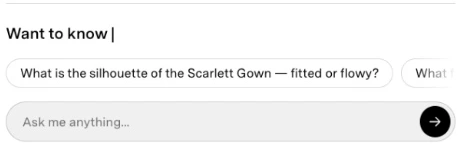
Kinect’s Dynamic Product Pages show an A.L.C. product page with a question about the Scarlett Gown’s silhouette. The existing screenshot below isolates that product-specific question and the input for a follow-up. It documents the interface Kinect publishes; it does not establish how any customer answered or whether the feature increased sales.
For an evaluation, bring a real SKU and its source records. Have the vendor show where each answer comes from. Then ask the same question when a required attribute is missing and review how the system handles the gap. Treat a fluent but unsupported answer as a failed check.
How do I keep an AI chatbot's answers consistent with my Shopify product pages?
Give the team reviewing answers the same product and policy records used to maintain the storefront. Check factual statements against those records, including variant-specific details. When a source is missing or conflicting, require a clear handling rule before launch. Repeat the checks after catalog updates so previously approved answers do not become stale.
Kinect identifies product information, size guidance, reviews, and policies as sources for its product-page answers. That gives a buyer a practical acceptance test: select an answer, locate its source, and verify that both describe the same item. The AI Sales Rep is the related experience for shoppers who need a longer conversation.
Keep a small review sheet with the real question, SKU, source field, expected factual content, returned answer, reviewer, and review date. Record missing evidence explicitly. Do not convert an assumption about fit, compatibility, or delivery into a confirmed product claim.
Demo acceptance check
Ask the vendor to show an answer that can be verified, an answer requiring a missing fact, and an answer affected by a recent policy change. Record what happens in each case.
How can I make the product page match the promise in my ad creative?
Compare the ad’s specific promise with the product and variant at the destination. Give the shopper a clear path to the evidence for that promise: a specification, image, size explanation, or policy. If the product cannot support the claim, correct the campaign before adding personalized wording to the product page.
Keep the campaign and catalog owners in the same review. Ask them to identify the promise, its supporting fact, and the place where a shopper can verify it on a phone. A product question can help explain an accurate claim, but the team still has to supply the evidence.
Use the wider ecommerce personalization guide when the decision spans product ordering, recommendations, and page content. For this product-page test, hold the destination and audience definitions steady and record other campaign changes that could affect the result.
What should I look for in a Shopify personalization app?
For product-page work, evaluate the app against the obstacle you documented. Review its source data, mobile placement, handling of unanswered questions, and measurement design. Ask to see the experience on your own products before accepting a general demo as proof. Keep purchase completion and answer accuracy on the review sheet alongside engagement.
Kinect’s measurement method assigns visitors to persistent test and control groups and compares outcomes on the same store during the same period. Its order attribution requires a message or a recommended-product click before purchase. Attribution and a randomized test answer different questions; review both definitions with the vendor.
Write the decision rule before launching. Select a primary outcome such as purchase conversion or revenue per assigned visitor, define its denominator, and set guardrails for returns, incorrect answers, and mobile usability. Your analyst should set the required sample and duration. If the test remains inconclusive, retain that status.
Shoppers who choose to use an assistant may already be more likely to buy. Report their conversion rate as an engaged-cohort measure. A screenshot, more messages, or a higher conversion rate in that self-selected cohort does not establish store-wide causal lift.
| Readout | What it can tell the team | Decision limit |
|---|---|---|
| Answer review | Whether sampled answers match verified product facts | Cannot establish sales impact. |
| Engagement | Whether shoppers use the added experience | Cannot establish incremental purchases. |
| Attributed orders | Whether an order followed the defined interaction | Does not supply the counterfactual. |
| Randomized test and control | Whether assigned groups differ on the chosen outcome | Requires adequate data and a valid test. |
Frequently asked questions
Why are shoppers leaving my product pages?
Inspect the actual obstacle: missing product facts, hard-to-find policies, variant-selection problems, or a mismatch with the campaign. Combine real customer questions with page behavior; a bounce count cannot establish the reason by itself.
How can I improve ecommerce conversion without redesigning my whole store?
Start with one documented obstacle on the existing page. Test a content correction, clearer placement, or product-specific answers, and evaluate the purchase outcome against a control.
How do I keep an AI chatbot's answers consistent with my Shopify product pages?
Review answers against the current catalog and policy records for the same product and variant. Define how missing or conflicting facts should be handled and repeat the checks after source updates.
How can I make the product page match the promise in my ad creative?
Identify the ad claim, verify its supporting product fact, and make that evidence easy to find at the destination. Correct an unsupported campaign claim before adding personalized explanations.
What should I look for in a Shopify personalization app?
For product-page work, check the data sources, mobile experience, handling of missing facts, and measurement method. Ask for a demonstration using your catalog and a test plan that separates engagement from causal sales impact.
Related reading