5 min readAgentic payments
The Visa, Mastercard, PayPal Agentic Commerce Partnership Map

By Kratik Agrawal
Published Jul 30, 2026

In about eighteen months, every company that moves money at scale picked a lane in agentic commerce. Visa built a developer platform. Mastercard built a payments rail and wired it into PayPal's wallet. PayPal also signed with Google. Amazon and Walmart decided the agent should be theirs.
The announcements sound like alphabet soup. Intelligent Commerce, Agent Pay, AP2, ACP. But the map underneath is simple. Three or four alliances, all answering the same question: who vouches for the AI agent knocking on your checkout? Here's the map, and what each piece actually means if you run a store.
Quick answer
Visa built Intelligent Commerce, its own rail for registered agents. Mastercard built Agent Pay and put it inside PayPal's wallet in October 2025. PayPal also signed a multiyear partnership with Google around the AP2 protocol. Amazon and Walmart built their own agents instead. Merchants integrate none of it. The work left for a brand is being the store the agent picks, which comes down to how readable your catalog and policies are.
Why the payment giants moved first
The card networks spent fifty years building fraud systems that flag exactly what a shopping agent looks like. A non-human, acting at a distance, on someone else's card. So if agent-led buying was going to happen at all, the networks had to build agents a legitimate front door. Otherwise their own rails decline the future.
Every initiative below is the same three-part idea wearing a different logo. Register the agent. Tokenize the authority the human gave it. Let merchants see agent-originated transactions as their own category instead of probable fraud. That's it. That's the whole map. The deeper mechanics, tokens, mandates, and machine-native rails are in Agentic payments, explained.
4
major rails with a named agentic program: Visa, Mastercard, PayPal, Google
100+
organizations backing Google's AP2 protocol by late October 2025
≈3×
Walmart's reported conversion edge for handing shoppers to its own site vs in-chat checkout
The agentic commerce partnership map, in one table
Every alliance, what it actually is, and the part that matters: what it asks of you.
| Alliance | What it is | Announced | What you do |
|---|---|---|---|
 | Developer platform connecting AI agents to Visa's network on tokenized, limit-scoped credentials | Apr 2025 | Nothing. Arrives through your acquiring stack |
 | Registered-agent tokens plus an acceptance framework for agent transactions | 2025 | Nothing. Watch your PSP's terms updates |
 | Agent Pay inside PayPal's branded checkout wallet, passkey-authenticated | Oct 27, 2025 | Offer PayPal checkout. That's the whole ask |
 | Multiyear partnership on AI shopping surfaces, built around the open AP2 mandate protocol | Sep–Oct 2025 | Nothing directly. Your platform adopts the protocol |
  | Own agents: Buy for Me and Rufus at Amazon, Sparky plus an OpenAI deal at Walmart | 2025–2026 | Be readable. Their agents shop your product data |
Visa agentic commerce: Intelligent Commerce
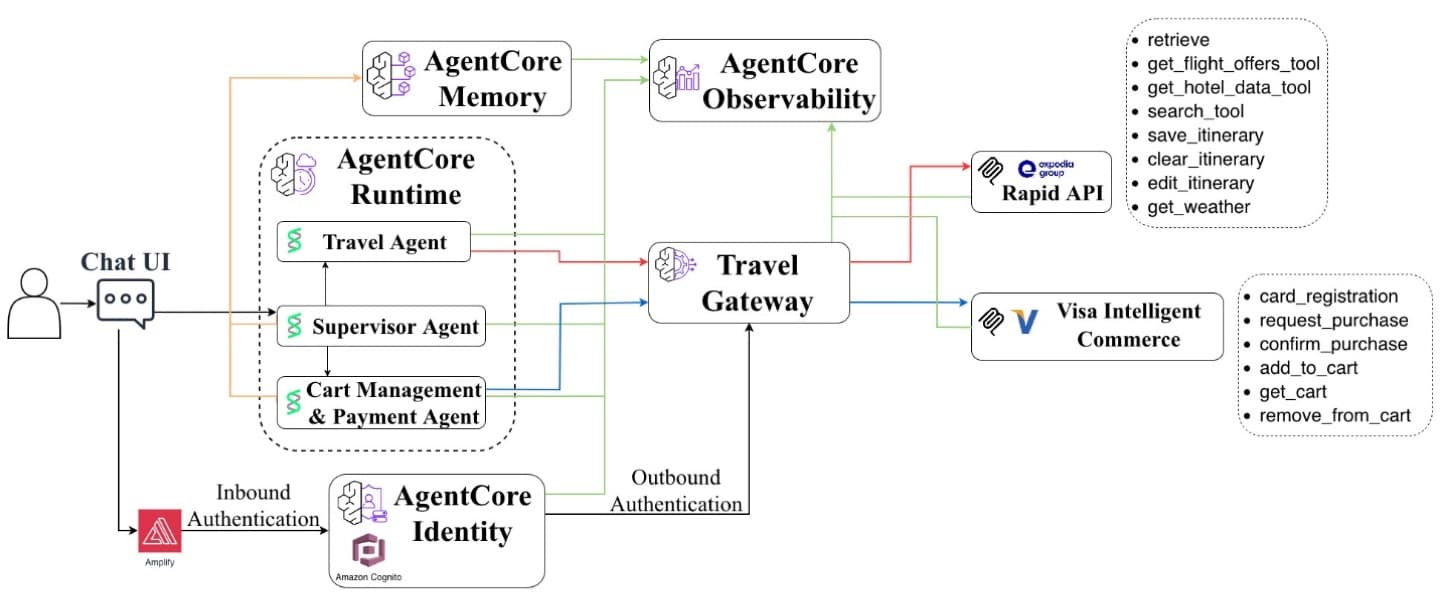
Visa launched Intelligent Commerce in April 2025. It's a developer platform: AI companies plug their agents into Visa's network, and agent transactions run on tokenized credentials tied to a real cardholder, with spending controls attached. Someone tells their assistant 'book the cheaper flight if it drops under $300' and the network can see a registered agent acting inside limits a human set. Visa says hundreds of agent-initiated transactions have already completed in controlled real-world environments.
Two expansions worth knowing. Intelligent Commerce Connect packages this for platforms, now in pilot with AWS, Aldar, Firmly, and Nekuda testing first. And Visa put Intelligent Commerce on AWS Marketplace with open blueprints for building agent payment flows on Amazon Bedrock. The bet is simple: be the default rail wherever agents get built, and don't bother owning an agent yourself.
Mastercard agentic commerce: Agent Pay
Agent Pay is Mastercard's version of the same move. Agents register into the program. Transactions carry agentic tokens that say 'this is a known agent acting for this cardholder.' Issuers and merchants can permission and risk-score agent traffic as its own lane.
The piece to actually watch is the Agent Pay Acceptance Framework. It's the rulebook for how agent transactions present at your checkout and who eats the loss when a delegated purchase goes wrong. That rulebook arrives inside the acquiring stack you already have. Which is why most of this page is, for you, a no-op. That's on purpose. The networks want zero merchant work standing between them and agent volume.
The Mastercard and PayPal agentic commerce partnership
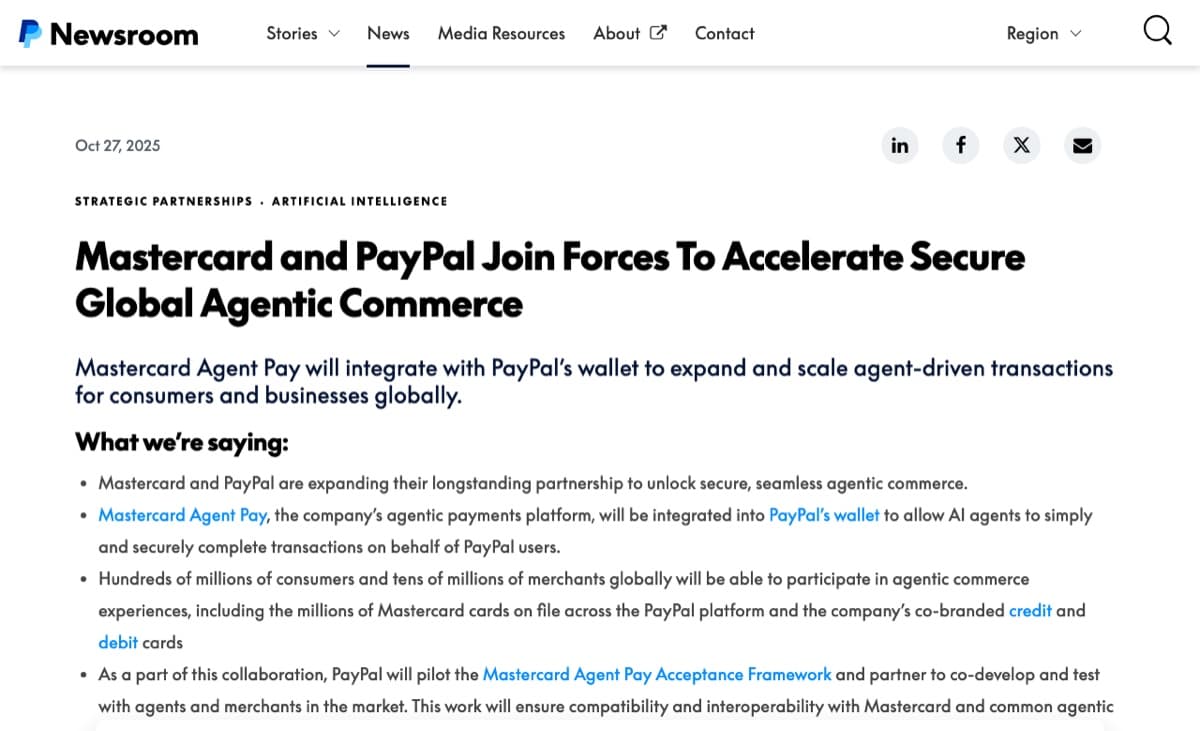
October 27, 2025: Mastercard's Agent Pay goes inside PayPal's branded checkout wallet. An AI agent can complete a purchase for a PayPal user, authenticated with Mastercard's tokenization and passkeys. PayPal is also piloting the Acceptance Framework and co-testing interoperability with agents and merchants in market.
Why this one matters: reach. PayPal checkout sits on tens of millions of merchant sites. The stated design goal is that those merchants accept agent-originated payments with no additional technical work. The agent authenticates to the wallet. The wallet presents to your checkout the way it always has. All the agentic plumbing stays a layer below you.
The big unlock
If your store already offers PayPal checkout, you're wired into agent payments the day this ships. No integration, no new contract, nothing to build. That's the whole point of putting the rail inside a wallet merchants already accept.
The Google and PayPal agentic commerce partnership
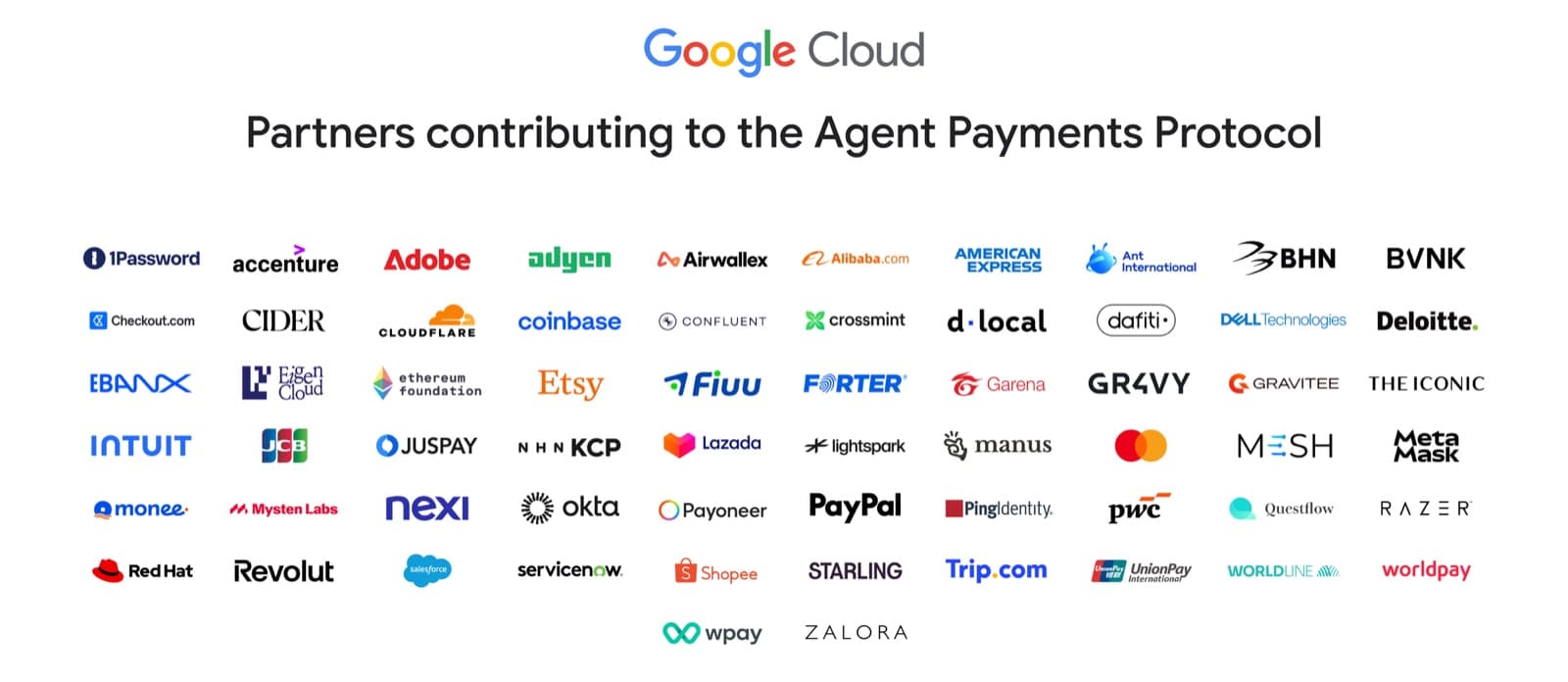
PayPal's other alliance is bigger than a wallet integration. September 2025, Google announced AP2, the Agent Payments Protocol. It's an open standard built on signed 'mandates,' records of exactly what a human authorized an agent to buy. Sixty-plus launch partners, including PayPal, Mastercard, American Express, and Adyen.
Then in late October PayPal and Google made it a multiyear strategic partnership. PayPal's payment infrastructure and identity plugged into Google's AI surfaces, plus a Conversational Commerce Agent built with Google Cloud. By that announcement, AP2's backer list had passed one hundred organizations.
Notice what PayPal is doing. It's inside Mastercard's rail and inside Google's protocol at the same time. For a wallet whose entire value is being accepted everywhere, that's not indecision. That's the strategy.
Amazon and Walmart: the retailers answer differently
The networks assume shopping agents will roam the open web. The two biggest retailers are testing the opposite bet: the agent worth owning is your own.
Amazon keeps expanding Buy for Me, which lets its app buy from third-party brand sites on a shopper's behalf, and keeps pushing Rufus from Q&A toward comparison and purchasing. Walmart built its own intelligence, Sparky, and kept the basket, the data, and the relationship inside its ecosystem. Then it also partnered with OpenAI so people can buy Walmart products inside ChatGPT. Covering both doors.
The number worth stealing from all this is Walmart's. They've reported that purchases completed inside a chat convert at roughly a third the rate of just sending the shopper to walmart.com.
Key insight
If you're not Amazon or Walmart, that gap is the finding. Agents are turning into a discovery and handoff layer. The storefront they land on still does the selling. Which means the storefront still has to be good at it.
What the map means for your store
On payments: you do almost nothing, and that's the design. Visa and Mastercard are building agent recognition into rails you already accept. PayPal is wiring it into a wallet you probably already offer. Google is standardizing the permission grammar. Nobody in this post is asking you to integrate a protocol.
What none of it solves is whether the agent picks you. Every system above moves money after the agent already chose a product. And agents choose from what they can read: your catalog data, your policies, your stock, your answers to the questions shoppers actually ask. Someone asks their assistant for 'a duvet that won't overheat a hot sleeper' and the brand with readable fill-weight data gets the recommendation. The one with a pretty PDP and empty metafields doesn't. That's the mechanics behind why AI assistants get products wrong, and it's fixable.
That layer is yours, and it's the one Kinect works on. The idea is simple: make your store legible with an agent-ready storefront, and put an AI sales rep on it for the shoppers agents hand off.
The networks handle the paying. Legibility decides the picking.
Frequently asked questions
Do merchants need to sign up for Visa Intelligent Commerce or Mastercard Agent Pay?
No. Both programs register agents and their developers, not merchants. Recognition of agent transactions arrives through your existing acquiring and PSP stack. Watch your provider's terms updates. Don't build anything.
Which agentic commerce partnership matters most for a DTC brand?
The Mastercard and PayPal one, for reach. If you offer PayPal checkout, agent-originated payments are designed to arrive through it with no extra work. The protocol layer, AP2 and ACP, matters more to your platform than to you directly.
Should I block AI shopping agents until the payment rails settle?
No. Blocking agents mostly removes you from consideration while competitors get recommended. The payment side is conservative by design: tokenized, human-confirmed, disputable on existing rails. The real risk is an agent reading stale or thin product data and describing you wrong. How AI shopping agents read stores covers what they actually see.
Related reading