6 min readGuide
AI agents for ecommerce work two sides of the counter

By Kratik Agrawal
Published Aug 15, 2026 Updated Aug 15, 2026
"AI agent for ecommerce" now names two opposite things. One is an agent that shops on behalf of a consumer: ChatGPT researching products, comparing options, and since late 2025 completing checkout inside the conversation. The other is an agent that sells on behalf of a store: answering shoppers, enriching the catalog, adapting product pages.
A brand evaluating "an AI agent" is really making two separate decisions — how to show up well to the agents shopping at you, and which agent to hire to sell for you. This guide maps both sides and gives you the evaluation checklist for the second one.
Quick answer
An AI agent for ecommerce is software that acts autonomously in a commerce conversation. Buyer-side agents, like ChatGPT with shopping and checkout, act for the consumer: they research, compare, and increasingly purchase. Brand-side agents act for the store: an AI sales rep converts shoppers on the site, and supporting agents keep the catalog and storefront readable to machines. Brands need a strategy for both, because the first kind decides whether you get recommended and the second decides whether visitors buy.
Buyer-side agents: the ones shopping at you
The buyer's side moved fast. ChatGPT added product results and shopping research, OpenAI opened a merchant program with its own product feed specification, and agentic checkout now lets a shopper complete a purchase without visiting the store. Shopify wired its merchants into these surfaces at the platform level. The mechanics are covered in how ChatGPT shopping works and Shopify agentic checkout, explained.
You do not install a buyer-side agent. You get read by it. Its picture of your brand comes from your product data, your pages, and your feed, which turns catalog quality into distribution: an agent recommends the products it can parse, compare, and defend to its user. The work of being parseable is the agent-ready storefront, and the checklist version is the agent-ready Shopify store checklist.
Brand-side agents: the ones selling for you
Brand-side agents divide by what they are hired to do, and the split runs along the same line as your inbox: selling versus support.
Selling agents work the pre-purchase conversation. The reference job is the AI sales rep: it greets intent, asks a clarifying question or two, recommends with reasons, and answers the hesitation that would otherwise close the tab. Behind it sit quieter agents doing storefront work — catalog enrichment filling in product data, dynamic product pages adapting to shopper context.
Support agents resolve tickets: order status, returns, delivery. Helpdesk platforms ship these, meter them per resolution, and measure them on deflection. They earn their keep after the sale, and the case for keeping them out of the selling seat is made in AI sales rep vs chatbot.
There is a third thing operators mean by the phrase: back-office automation agents that reconcile ad spend, watch inventory, and draft daily reports. Useful, and a different purchase — those save hours, while the two kinds above decide revenue. This guide covers the revenue kinds.
| Agent type | Acts for | The job | Judged on |
|---|---|---|---|
Shopping agent ( ChatGPT, ChatGPT,  Perplexity, Perplexity,  Copilot) Copilot) | The consumer | Research, compare, and increasingly check out | Whether its user trusts the recommendation |
 AI sales rep AI sales rep | The brand | Convert the shoppers already on the site | Revenue against a baseline |
| Catalog and storefront agents | The brand | Enrich product data, adapt pages, stay machine-readable | Data completeness and what gets recommended |
| Support agent | The brand | Resolve post-purchase tickets | Deflection rate and time-to-answer |
| Ops automation agent | The brand | Back-office workflows: reporting, inventory, ad reconciliation | Hours saved |
How merchants actually talk about this
The store-owner threads are less about protocols and more about a blind spot. The question that keeps recurring, here from r/AutomateShopify (July 2026): "I have been seeing more people talk about getting traffic from chatgpt... but I still don't understand what actually makes a Shopify store show up in recommendations."
The operators who went looking for the answer ran tests. One in r/ecommercemarketing (June 2026) took "~30 questions a real buyer would ask in my category," asked them across ChatGPT, Gemini, Perplexity, Claude, and Grok with web search on, and repeated each "so one random answer doesn't fool me" — which is the right experimental design, and the same probe-set idea behind professional AI-visibility tracking.
The other half of the threads are brands asking for the selling kind: the boutique owner drowning in "is this in stock, what sizes are left, do you ship here" DMs, and operators asking which agents "actually moved the needle" versus demos. The vocabulary is messy; the two underlying purchases — get recommended by the agents, convert the traffic you already have — are exactly the two sides of the counter this page maps.
How to evaluate a brand-side agent
Four questions separate the serious platforms from the widgets, and none of them is about the demo.
- What is it trained on? A selling agent grounded in your catalog, policies, and past conversations can explain a recommendation. One trained on a guidance doc answers like a brochure.
- Whose voice does it speak in? The rep is on your storefront saying words to your customers. Tuning to your brand's voice is table stakes for a selling agent; generic-bot cadence costs trust with every reply.
- How does it handle what it should not answer? The honest pattern is routing: support questions go to your helpdesk, and the agent declines to invent. An agent that fabricates an answer about compatibility costs you a return and a review.
- How is it measured? Advertised ROI multiples tell you about the vendor's best quarter. An A/B split against your own baseline tells you about your store. Ask for the methodology in writing before you sign.
The measurement question deserves the most weight, because it is the one you cannot retrofit. Kinect publishes its methodology at how we measure: every store launches behind an A/B split, and revenue is reported against the store's own baseline.
Where Kinect fits
Kinect builds the brand's side of the counter as one platform. A single intelligence trained on your catalog, customers, and conversations runs the AI sales rep, fills in the catalog, adapts product pages, and keeps the storefront readable by the buyer-side agents — so the work you do for one side compounds into the other.
The industry is building agents to help people buy. Kinect builds agents that help brands sell. Brands running it see 3 to 6% more revenue against their own baselines, with same-day go-live and no theme rebuild.
Frequently asked questions
What is an AI agent for ecommerce?
Software that acts autonomously in a commerce conversation. Buyer-side agents like ChatGPT shopping act for consumers: researching, comparing, and completing purchases. Brand-side agents act for stores: an AI sales rep converting shoppers on the site, catalog agents enriching product data, and support agents resolving tickets. Operators also use the phrase for back-office automation agents, a separate, hours-saving category.
What is the difference between an AI agent and a chatbot?
Autonomy and grounding. A scripted chatbot follows flows your team wrote. An agent decides its next step itself: which clarifying question to ask, which products to recommend and why, when to route to a human or a helpdesk. On a storefront the difference shows up as a rep that sells versus a widget that deflects — the full comparison is in AI sales rep vs chatbot.
Can AI agents complete purchases?
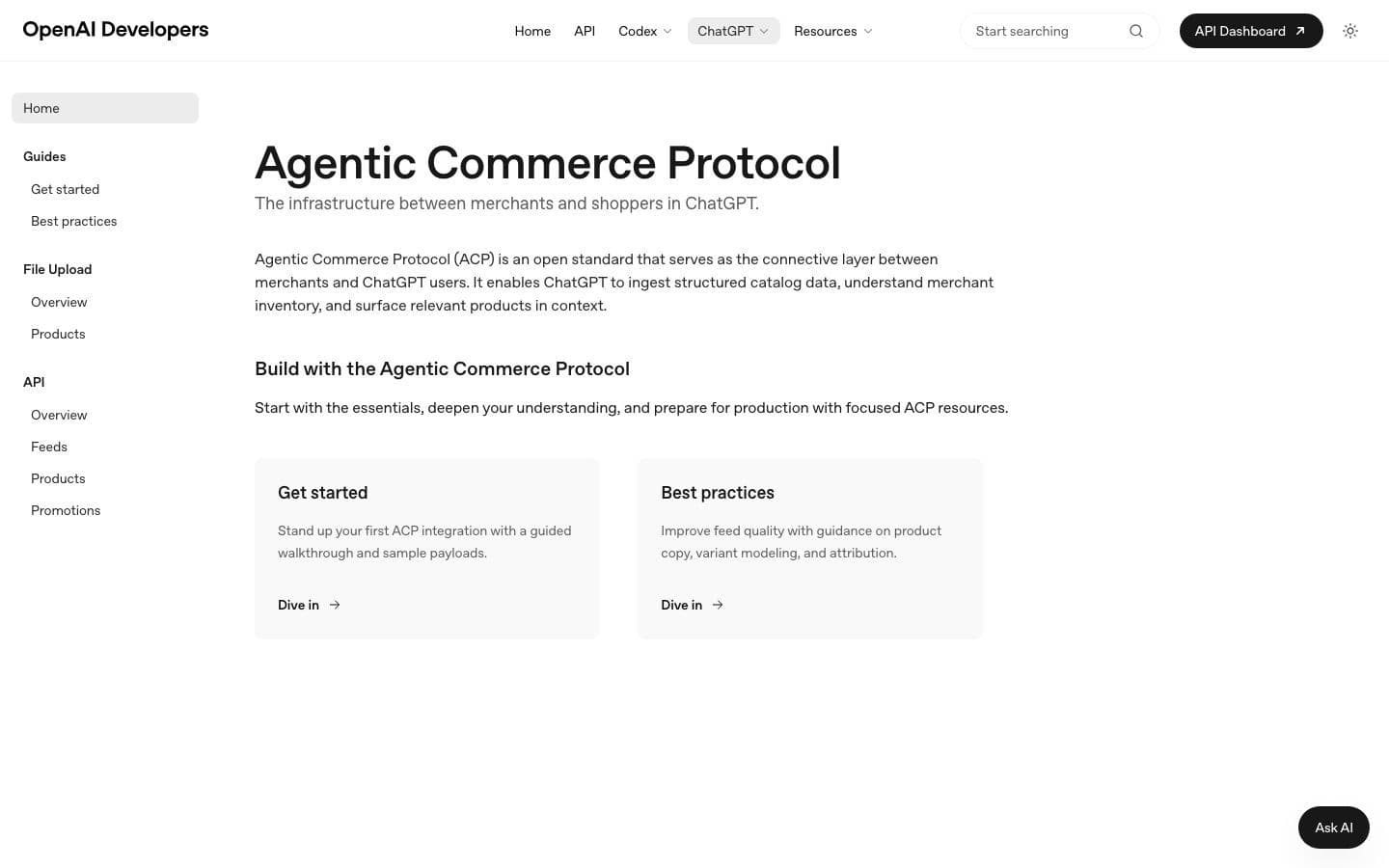
Yes. Agentic checkout lets a shopper buy inside the conversation — ChatGPT supports instant checkout with Shopify merchants, and protocols like ACP and UCP standardize how agents transact with stores. The moving parts are covered in agentic checkout, explained and ACP vs UCP.
How do I make my store visible to AI shopping agents?
Feed them data they can parse: complete product descriptions, identifiers on every variant, accurate price and availability, structured data in the page, and a feed that matches the store. The working checklist is the agent-ready Shopify store checklist, and Kinect's agent-ready storefront does the job as a product.
How do I know if ChatGPT recommends my products?
Test it the way operators do: write out the questions a real buyer would ask in your category — "best [product] for [use case]", "[competitor] alternatives" — ask them across ChatGPT, Perplexity, and Gemini with web search on, and repeat each several times so one random answer does not mislead you. Track your appearance rate over time; that number is your AI shelf presence.
What results should I expect from an AI agent on my storefront?
Demand a measured number rather than an advertised one. Brands running Kinect see 3 to 6% more revenue against their own baselines, and shoppers who engage the rep convert at 6 to 21% — a cohort measure, not a causal claim. The methodology is published at how we measure.
Do I need a buyer-side strategy and a brand-side agent?
Increasingly, yes, and they share a foundation. The catalog data that lets a sales rep explain a recommendation is the same data that lets ChatGPT parse and recommend your products. Fixing it once serves both sides of the counter.
Related reading