7 min readComparison
Gorgias alternatives, sorted by the job you are hiring for

By Kratik Agrawal
Published Aug 15, 2026 Updated Aug 15, 2026
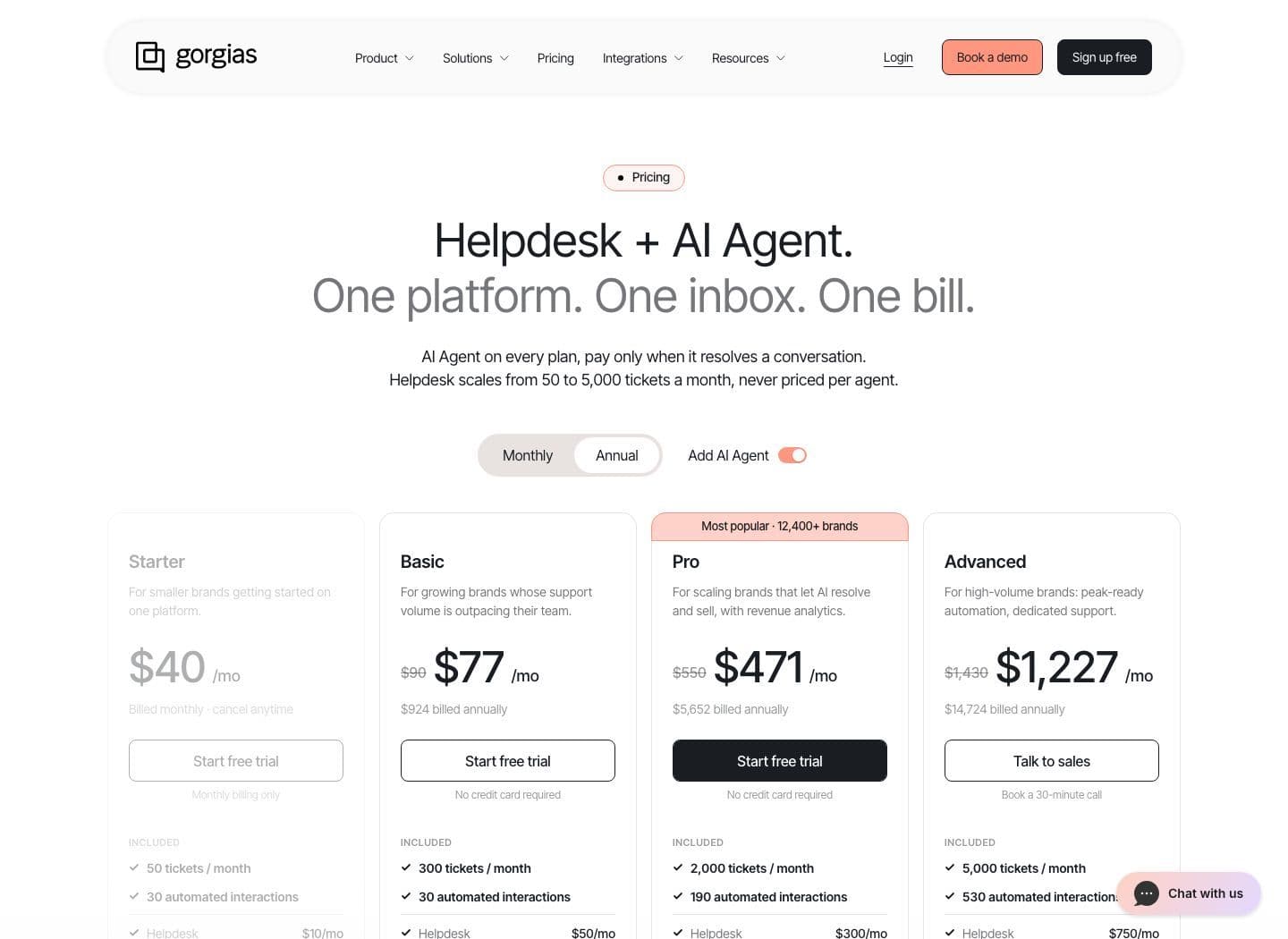
Gorgias is the support backbone for thousands of Shopify brands: a multichannel inbox for email, chat, SMS, and social, an AI Agent that advertises 60% of inquiries resolved instantly, and since 2025 a Shopping Assistant inside the chat widget. Brands shopping for an alternative usually have one of three reasons: the metered AI pricing stopped penciling out, the support volume outgrew the platform, or the AI on the storefront keeps closing tickets when the brand wanted it closing sales.
The right alternative depends entirely on which reason is yours, so this list is sorted by job rather than by star rating. Six of the nine are support platforms competing for Gorgias's actual job. Three are selling tools, for the case where the dissatisfaction was never really about tickets.
Quick answer
The best Gorgias alternative depends on the job. For ticket resolution: Siena for DTC-focused automation, Tidio for smaller self-serve teams, Intercom Fin for per-resolution AI in the Intercom ecosystem, Zowie or Ada for enterprise scale, Alhena for a grounded generalist from $199/mo. If the real complaint is that the AI on your storefront deflects instead of sells, the alternative is a revenue tool: Kinect for a white-glove AI sales rep measured on revenue, or Zipchat and Rep AI for self-serve selling widgets.
How to choose
Start from your ticket mix. If most conversations are order status, returns, and delivery, you are shopping for a helpdesk and the six support platforms below are the real shortlist. If a meaningful share of conversations are sizing, compatibility, and this-or-that questions, those are sales conversations, and the honest fix is a selling layer beside your helpdesk rather than a different helpdesk.
Also decide who does the setup. Gorgias is self-serve: your team connects sources, writes guidance, and configures the AI. Some alternatives keep that model at lower or higher scale. Others, Kinect among them, deliver white-glove — the vendor's team trains and tunes the system and is accountable for a number.
And read the meter before you sign anything. Gorgias's published plans run $40 a month (Starter) to $1,227 a month (Advanced, billed annually), sized by ticket volume from 50 to 5,000 tickets, with the AI Agent billed per conversation it resolves on top. Metered pricing is the single most common reason the switching threads exist.
| Tool | Job | Setup | Pricing shape |
|---|---|---|---|
 Kinect Kinect | AI sales rep + catalog and storefront jobs, measured on revenue | White-glove, live same day | Custom per store |
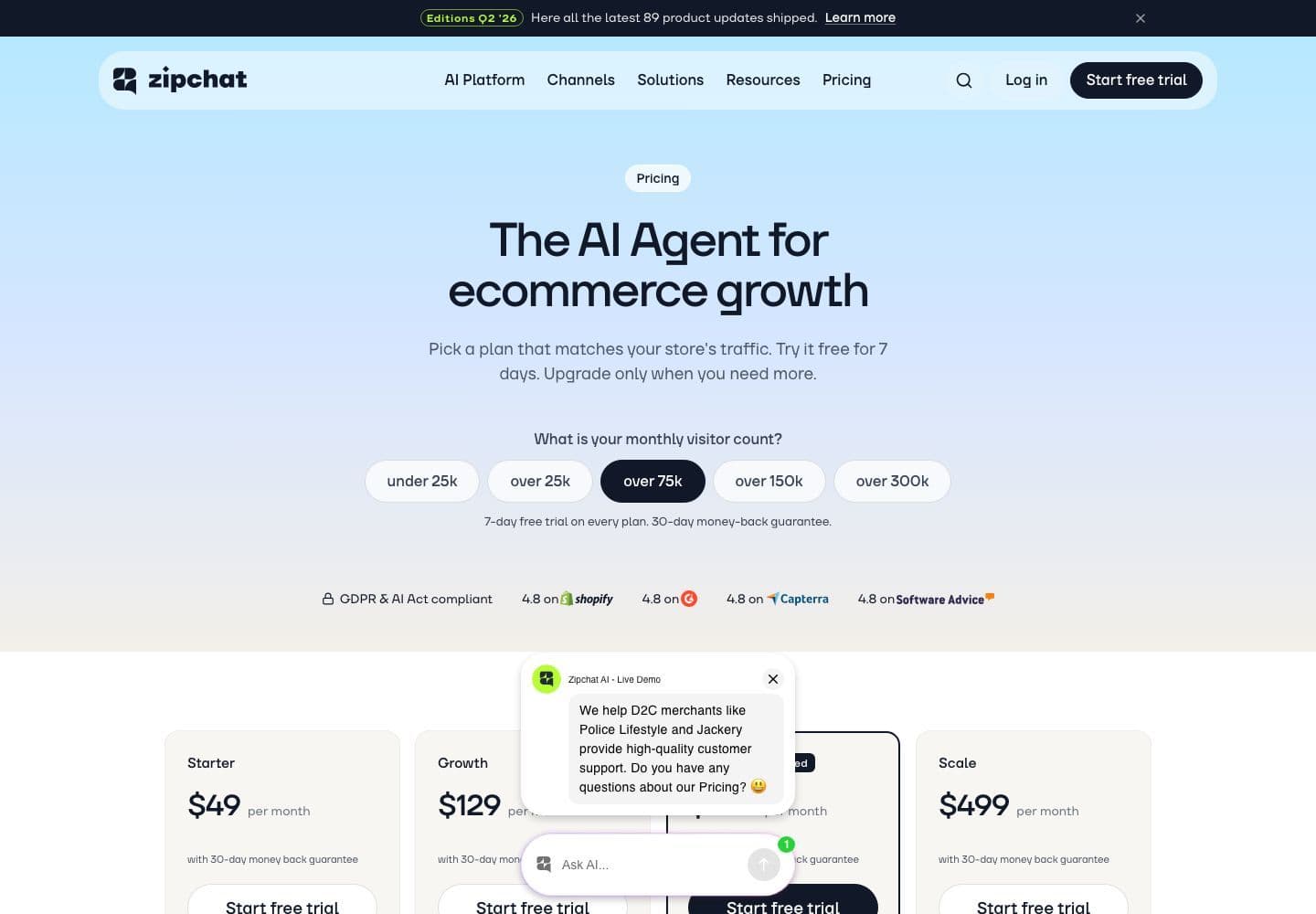
 Zipchat Zipchat | Self-serve selling widget with cart recovery over WhatsApp | Self-serve | From $49/mo, metered per AI reply |
 Rep AI Rep AI | Sales-plus-support chatbot triggered on behavioral signals | Self-serve | App-store tiers |
 Siena Siena | DTC support automation on top of your helpdesk | Sales-led | Sales-led |
 Tidio Tidio | Self-serve support toolkit for smaller teams | Self-serve | Free tier, metered per conversation |
 Intercom Fin Intercom Fin | AI resolution inside the Intercom ecosystem | Self-serve | Per resolution |
 Alhena Alhena | Grounded assistant spanning shopping, support, and voice | Self-serve | From about $199/mo |
 Zowie Zowie | Enterprise support automation across chat, email, voice | Sales-led | Sales-led |
 Ada Ada | Enterprise agentic CX at very large scale | Sales-led | Sales-led |
What switchers actually say
The switching threads are specific about why they exist. The most common trigger is the meter. A brand doing 1,500 tickets a month in r/shopify (February 2026, 61 comments): "I want to start using Gorgias AI Agent to automate tickets and also add voice support inside Gorgias, but the cost is insane. Right now I'm estimating roughly $500+/month for ~400 AI Agent ticket resolutions."
The second trigger is what counts as a ticket. A mid-sized brand in r/ChoosingVendors (July 2026): "gorgias is charging us a fortune because their system counts basic automated order tracking emails as 'tickets.' we are getting penalized just for sending shipping updates." The recurring ask in those threads is a helpdesk that "charges per user seat instead of per ticket."
Third is whether the Shopify-native premium is worth it at all. An operator pricing both in r/CRM (September 2025) put it plainly: Zendesk at about $115 a month against Gorgias at $300 to $360 for the same volume — "triple the price, but supposedly amazing for Shopify-native workflows" — and asked whether that holds at one to four seats.
And on the AI itself, a DTC operator who tested the field for three weeks wrote the bluntest reviews in r/learnmachinelearning (December 2025): Gorgias AI is "good if you're already on Gorgias... but sounds generic as hell and you can't really train it"; Siena "actually handles 60% of tickets autonomously" but "when it's wrong, it's CONFIDENTLY wrong"; Tidio is "set up in 2 hours" though its "product recommendations are brain-dead." One operator's scores, not a benchmark — but the axes are the right ones: grounding, voice, and price.
Notice what nobody in these threads complains about: the inbox. The multichannel consolidation is the part Gorgias does well. The complaints are the meter and the AI, which is exactly why "switch helpdesks" and "add a selling layer" are different fixes for different complaints.
If the AI should sell: Kinect, Zipchat, Rep AI
Kinect is the alternative for the third reason on the list — you watched Gorgias's Shopping Assistant recommend products from inside a support widget and wanted the job done properly. Kinect is a revenue platform rather than a helpdesk: one intelligence trained on your catalog, policies, customers, and conversations runs an AI sales rep that asks clarifying questions and explains recommendations in your voice, while the same intelligence fills in your catalog and keeps your storefront readable by AI assistants. Order and return questions route to your helpdesk on purpose — many Kinect stores keep Gorgias for exactly that. Brands see 3 to 6% more revenue, measured behind an A/B split against their own baseline, published at how we measure. The full head-to-head is at Kinect vs Gorgias.
Zipchat leads with selling at self-serve prices: a widget you install and train yourself, with proactive engagement, product recommendations, cart recovery over WhatsApp, and support deflection, metered per AI reply on published tiers from $49 a month. The trade against Kinect is depth versus speed-to-install; the detail is in Kinect vs Zipchat.
Rep AI is a sales-plus-support chatbot from the App Store that opens conversations on behavioral signals like hesitation and exit intent and automates tickets across chat, email, and social. Priced and packaged to be self-installed. Comparison at Kinect vs Rep AI.
If the job is tickets: Siena, Tidio, Intercom Fin, Alhena, Zowie, Ada
Siena is the closest like-for-like swap for a DTC brand: an AI CX platform that automates tickets on top of your helpdesk across email, chat, SMS, and social with empathic, on-brand replies, plus a Shopping Agent add-on for live chat. Detail at Kinect vs Siena.
Tidio serves the stage below Gorgias: a self-serve toolkit with live chat, no-code flows, and the Lyro AI agent, priced from free and metered per conversation. Right when you want an inexpensive widget running this afternoon. Detail at Kinect vs Tidio.
Intercom Fin is one of the best-known AI resolvers in software, built on a decade of B2B helpdesk DNA and priced per outcome. In 2026 Intercom extended it toward commerce with Fin for Ecommerce, a Shopify role that answers product questions and updates carts. Strongest when you already live in the Intercom ecosystem. Detail at Kinect vs Intercom Fin.
Alhena (formerly Gleen AI) is a self-serve grounded assistant spanning shopping, support automation, and voice: it constrains answers to approved brand content, ships a large helpdesk integration catalog, and publishes entry pricing around $199 a month. Detail at Kinect vs Alhena.
Zowie automates high volumes of support at mid-market and enterprise scale across chat, email, and voice, with commerce as one vertical alongside insurance and banking. The move up when ticket volume is the pain. Detail at Kinect vs Zowie.
Ada is enterprise agentic CX: support resolution at very large scale, across voice, messaging, and email, in dozens of languages, with the governance surface — Salesforce, Zendesk, ServiceNow — that enterprise service organizations require. Its ecommerce story is order tracking, returns, and FAQs rather than selling. Detail at Kinect vs Ada.
The pattern worth stealing
The strongest stacks in DTC do not replace Gorgias at all. They keep a helpdesk for tickets and add a selling layer for pre-purchase conversations, routed by intent. The reasoning is laid out in ecommerce customer service in 2026.
Where Kinect fits
Kinect competes for one specific version of this search: the brand whose complaint with Gorgias was never the inbox. The inbox is fine. The complaint was that the only AI talking to shoppers on the storefront treats a buying question as a ticket.
For that brand, Kinect is the alternative that changes the outcome: a sales rep whose entire job is converting the shoppers already on your site, delivered white-glove, live the same day, measured behind an A/B split — with Gorgias, if you keep it, doing what it does best behind the scenes.
Frequently asked questions
What is the best Gorgias alternative for Shopify?
It depends on the job. Siena is the closest DTC-focused swap for ticket automation, Tidio serves smaller self-serve teams from a free tier, Intercom Fin resolves per outcome inside the Intercom ecosystem, and Zowie and Ada serve enterprise scale. If the reason you are looking is that the AI should sell rather than deflect, the alternatives are Kinect, Zipchat, and Rep AI.
Is Kinect a Gorgias alternative?
Only for one of the three reasons brands search this term. Kinect is a revenue platform, not a helpdesk, so it does not replace the Gorgias inbox — many Kinect stores keep Gorgias and route order and return questions to it. Kinect is the alternative when the complaint is that the AI on the storefront closes tickets instead of sales.
What is the cheapest Gorgias alternative?
Tidio, which starts free and meters per conversation, serves the low end. Zipchat publishes tiers from $49 a month on the selling side, and Alhena publishes entry pricing around $199 a month. For reference, Gorgias's own published plans run $40 to $1,227 a month sized by ticket volume, with AI resolutions metered per conversation on top.
Why do brands leave Gorgias?
The switching threads name two triggers far more than any other: the metered AI pricing — one 1,500-ticket brand estimated $500+ a month for around 400 AI resolutions — and ticket-counting rules that bill automated messages like shipping updates as tickets. Almost nobody complains about the inbox itself, which is why some "switches" end as an added selling layer instead.
Does Gorgias do AI selling?
It added a Shopping Assistant to its chat widget in 2025 — product cards, add-to-cart, and discount offers inside the support conversation — and its homepage now leads with "Conversations that drive revenue, not just resolutions." It is a selling layer on a support-first product, configured self-serve and billed per AI resolution. The comparison against a dedicated sales rep is at Kinect vs Gorgias.
What should I check before switching helpdesks?
Three things: whether your ticket mix is actually a support problem or a selling problem, whether the AI pricing model matches your volume, and what the migration costs in macros, integrations, and team retraining. A meaningful share of "switching" projects end as an addition instead — the helpdesk stays and a selling layer joins it.
Related reading