7 min readGuide
Ecommerce customer service runs on two different jobs

By Kratik Agrawal
Published Aug 15, 2026 Updated Sep 22, 2026
Most guides to ecommerce customer service start with channels: email, chat, SMS, social. That framing hides the decision that actually determines your stack, because the messages arriving on those channels belong to two different jobs.
One job is post-purchase: where is my order, how do I return this, my discount code failed. The other is pre-purchase: does this run small, will it work with what I own, which of these two should I get. The first is a cost you want resolved cheaply. The second is revenue standing in your inbox. This guide covers both halves, the tools built for each, and the mistake of pointing one bot at the whole thing.
Quick answer
Ecommerce customer service is the work of answering shoppers before and after they buy, across email, chat, SMS, and social. In 2026 the post-purchase half runs on a helpdesk with AI resolving routine tickets, and the pre-purchase half is increasingly handled by a dedicated AI sales rep, because a question like "does this fit" is a buying signal, and a deflection bot is built to close tickets rather than sales.
What ecommerce customer service covers in 2026
The surface area has settled: a shared inbox across email, live chat, SMS, and social DMs, connected to your commerce platform so an agent can see the order behind the message. For Shopify brands that inbox is usually a dedicated ecommerce helpdesk rather than a generic support tool, because order context is the whole game — a return request without the order attached is just a sad email.
What changed since 2024 is who answers first. Every serious helpdesk now ships an AI agent that resolves routine tickets before a human sees them. Gorgias, the support backbone for thousands of Shopify brands, advertises 60% of inquiries resolved instantly. Enterprise platforms like Zowie and Ada automate support at much larger scale, across voice and dozens of languages.
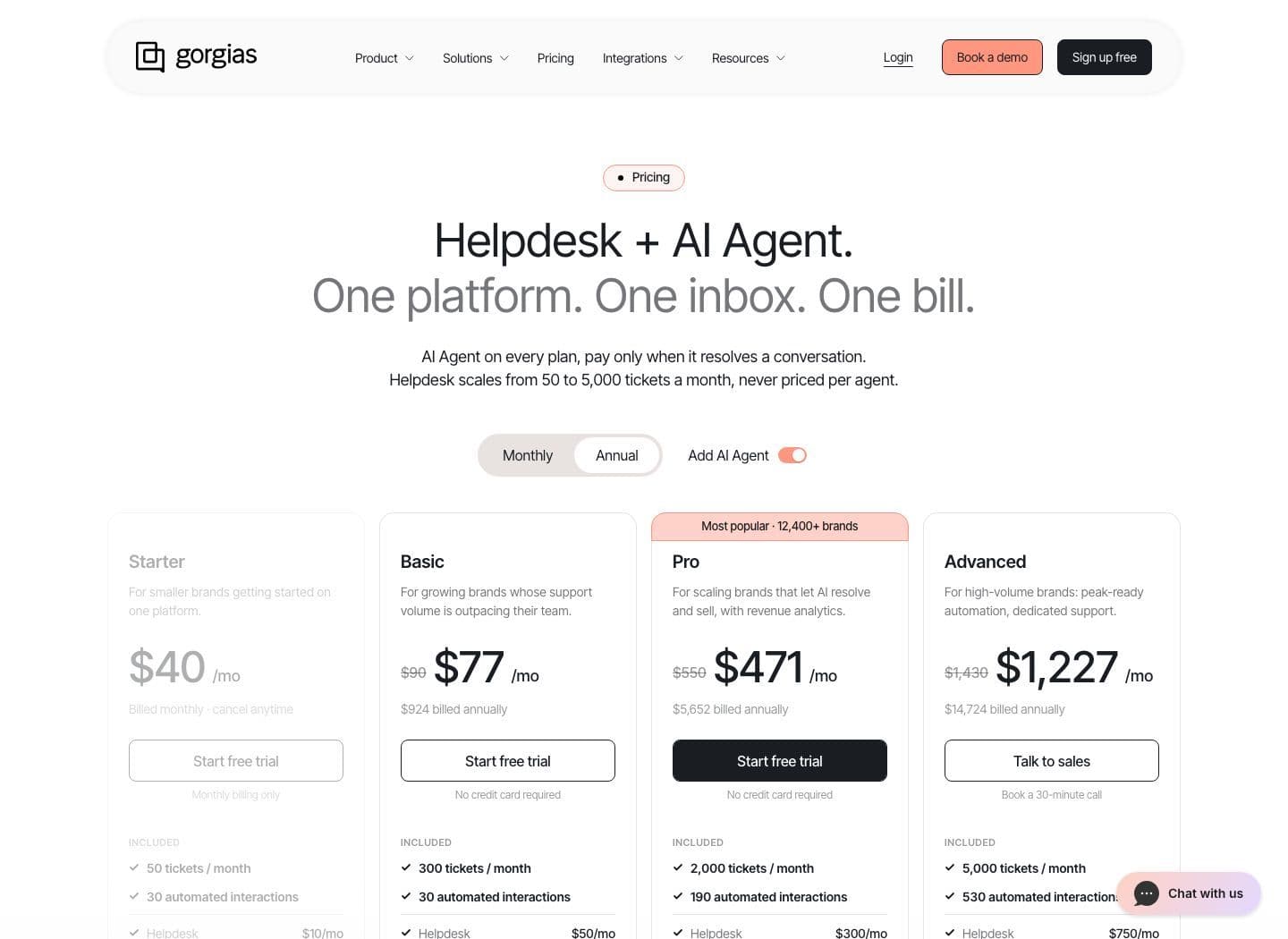
The economics are also settled: support AI is metered. Gorgias prices its helpdesk by ticket volume — 50 to 5,000 tickets a month across plans from $40 (Starter, monthly billing) to $1,227 a month (Advanced, billed annually, captured 15 August 2026) — with the AI Agent on every plan and billed per conversation it resolves. Intercom prices Fin, its AI agent, per resolution too. You pay per conversation closed, which tells you exactly what the tool is optimized to do.
60%
of inquiries Gorgias advertises as resolved instantly by its AI Agent
$40–$1,227
per month across Gorgias's published plans, sized by ticket volume, AI resolutions metered on top (gorgias.com/pricing, 15 Aug 2026)
6–21%
conversion rate for shoppers who engage a Kinect sales rep — a cohort measure, not a causal claim
The post-purchase half: resolve it cheaply, resolve it fast
Post-purchase tickets are the half where deflection is the right goal. Nobody wants a relationship with your returns portal. The shopper wants the tracking number, the refund, or the address change, and every minute of delay costs goodwill you already paid to earn.
The stack for this half is mature, and the honest differences between tools are stage and scale rather than capability.
| Tool | Built for | Pricing shape |
|---|---|---|
 Gorgias Gorgias | The default Shopify DTC helpdesk: multichannel inbox, deep order data, AI Agent resolving routine tickets | Ticket-volume plans $40–$1,227/mo, AI resolutions metered per conversation |
 Tidio Tidio | Smaller teams that want a self-serve widget with live chat, flows, and the Lyro AI agent | Free tier, then metered per conversation |
 Siena Siena | DTC brands automating tickets on top of an existing helpdesk with on-brand replies | Sales-led |
 Intercom Fin Intercom Fin | Teams already in the Intercom ecosystem; one of the best-known AI resolvers in software | Per resolution |
 Zowie Zowie | Mid-market and enterprise support volume across chat, email, and voice | Sales-led |
 Ada Ada | Enterprise service organizations: very large scale, dozens of languages, Salesforce/Zendesk/ServiceNow governance | Sales-led |
Pick by stage
Early store answering a handful of tickets a day: a self-serve widget is enough. Established DTC brand: an ecommerce helpdesk with AI deflection. Enterprise volume in multiple languages: that is Zowie and Ada territory.
The pre-purchase half is a sales job wearing a support costume
Read a week of your chat transcripts and sort them. A large share of "support" conversations happen before any order exists: sizing, compatibility, ingredient questions, this-or-that comparisons, gift advice. Each one is a shopper telling you exactly what stands between them and checkout.
A deflection bot handles that conversation the way it handles a return: find an answer, close the thread, count a resolution. The metric it reports is tickets avoided. A sales rep handles it the way a good floor associate does: ask the one clarifying question, recommend with a reason, address the hesitation, walk the shopper to the register. The metric that matters there is orders.
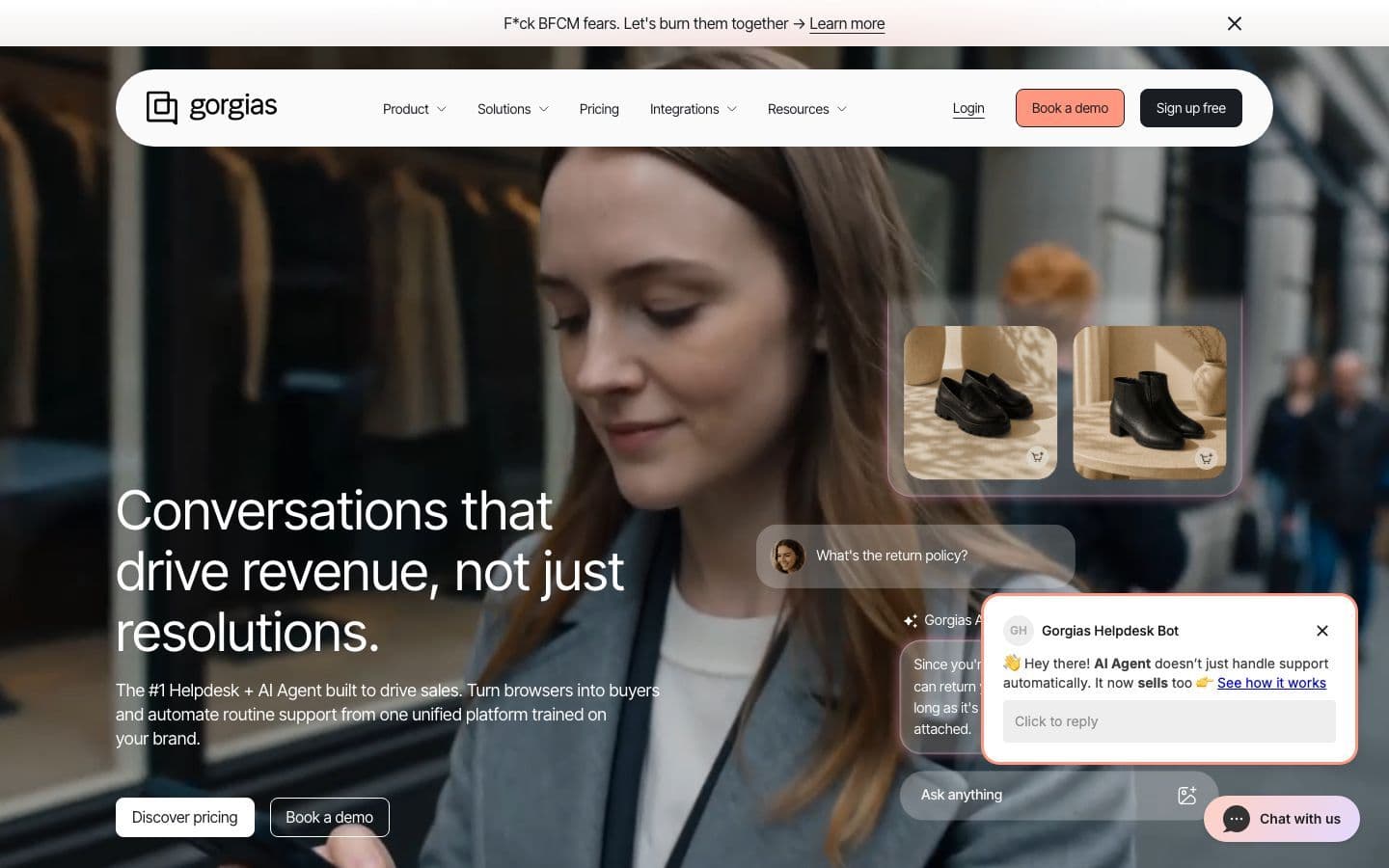
The tools reflect their incentives, and the support platforms know it: Gorgias's own homepage now leads with "Conversations that drive revenue, not just resolutions," and Intercom extended Fin toward commerce in 2026. A selling feature added to a deflection product still inherits the deflection product's brain, which was trained on your policies rather than your products. The fuller argument, with the product-by-product detail, is in AI sales rep vs chatbot.
What running the inbox actually sounds like
The threads where store owners compare notes describe the two halves without naming them. On the volume itself, a boutique owner in r/ecommerce (July 2026): "Every time I do a drop, the DMs flood in and it's the same questions over and over. Is this in stock? What sizes are left? How much? Do you ship here? When's the next restock?" Count those five questions: every one is pre-purchase.
A newer store owner in r/ecommerce (April 2026) describes the early mix the same way — "mostly sizing questions and delivery checks" — while asking when the snowball hits. A two-person team in r/shopify_growth (July 2026) answers that: "it feels like a full time job on top of actually running the store."
And on the tools most stores bolt on first, a thread in r/dropshipping (February 2026) opens with the whole problem: "Why do most ecommerce chatbots feel useless? Every time I visit a store and open chat, it just says: 'Hi! How can I help you?'" A greeting is not an answer, and it is certainly not a sale.
The pattern across dozens of these threads: the volume that buries small teams is buying questions, and the widgets they try first are built for tickets. That mismatch is the argument for splitting the two jobs.
How the two halves fit together
Run them side by side, and route by intent. The pattern Kinect ships by default: the AI sales rep works every pre-purchase conversation on the storefront, and the moment a shopper asks about an order, a return, or a delivery, the conversation routes to your helpdesk — very often Gorgias itself. Neither tool does the other's job badly, because neither is asked to.
The division also cleans up your measurement. Support gets judged on resolution rate and time-to-answer. The sales side gets judged on revenue, which is the number a selling tool should have to defend.
- Route by intent, not by channel. Order status goes to the helpdesk. "Which one should I get" goes to the rep.
- Keep one owner per metric. Deflection rate belongs to support. Conversion and revenue belong to the selling layer.
- Ground the selling side in the catalog. A rep that cannot read fit, materials, and compatibility answers like a greeter, not a salesperson.
- Demand a defensible number. Aggregate ROI multiples advertise well; an A/B split against your own baseline is the measurement you can take to a board meeting.
Kinect publishes exactly how it measures — every store launches behind an A/B split, and revenue is reported against the store's own baseline. The methodology is at how we measure.
Where Kinect fits
Kinect is the pre-purchase half done as a whole job. One intelligence trained on your catalog, policies, customers, and conversations runs an AI sales rep on your storefront — clarifying questions, explained recommendations, answers in your voice — and routes support tickets to the helpdesk you already trust.
Brands running Kinect see 3 to 6% more revenue, measured against their own baselines, and shoppers who engage the rep convert at 6 to 21% — a cohort measure, published with the rest of the methodology at how we measure. Onboarding is white-glove and stores go live the same day, no theme rebuild.
Frequently asked questions
What is ecommerce customer service?
The work of answering shoppers before and after a purchase, across email, live chat, SMS, and social, with order context attached. In 2026 it splits into two jobs: post-purchase ticket resolution, run on a helpdesk with AI deflecting routine questions, and pre-purchase buying questions, increasingly handled by a dedicated AI sales rep.
What is the best customer service tool for a Shopify store?
For the support half, Gorgias is the default helpdesk for thousands of Shopify DTC brands, with Tidio serving smaller self-serve teams and Zowie or Ada serving enterprise volume. For the pre-purchase half, a selling tool measured on revenue does the job better than a support bot with a shopping feature. Many established brands run both, routed by intent.
Can AI fully handle ecommerce customer service?
It handles a large share of it. Gorgias advertises 60% of inquiries resolved instantly, and enterprise platforms automate more at scale. The half AI handles least well from inside a support tool is pre-purchase selling, because a deflection bot is optimized to close threads, and a buying question deserves a clarifying question back rather than a fast close.
How is an AI sales rep different from a support chatbot?
Training and incentive. A support chatbot becomes an expert in your policies and is metered per resolution, so it optimizes for closing conversations. A sales rep is trained on your products and customers and is measured on revenue, so it asks clarifying questions, explains recommendations, and works the hesitation. The full comparison is in AI sales rep vs chatbot.
Should pre-purchase questions go to my helpdesk?
Only if nothing better is on the storefront. A sizing or compatibility question is a shopper mid-decision, and every hour it sits in a ticket queue is an hour for the tab to close. The pattern that works: an AI sales rep answers pre-purchase questions on the spot, and order or return questions route to the helpdesk.
What should ecommerce customer service cost?
The support half is priced transparently and metered: Gorgias's published plans run $40 to $1,227 a month sized by ticket volume (50 to 5,000 tickets), with AI resolutions billed per conversation on top, and Tidio starts free. Selling-side platforms are typically scoped per store. The number to watch on the selling side is measured revenue against your own baseline, not the license fee.
Related reading