3 min readGuide
AI Chatbot for Ecommerce, and When You Need an Agent Instead

By Kratik Agrawal
Published Aug 25, 2026 Updated Sep 22, 2026
Every vendor in this category calls their product an AI chatbot, an AI agent, or both, usually on the same page. Underneath the labels there are two genuinely different jobs, and knowing which one you are hiring for decides whether the tool pays for itself.
This page draws that line, maps the tools on each side of it, and gives you the two questions that cut through any demo.
Quick answer
An AI chatbot for ecommerce answers shopper questions in a chat window, order status, sizing, returns, and deflects support tickets. That job is real and mature. The 2026 distinction is chatbot versus agent: a chatbot answers questions, an agent sells, greeting shoppers, qualifying intent, recommending, and closing. Buy by which job your store needs, not by the label on the pricing page.
What a chatbot actually does for a store
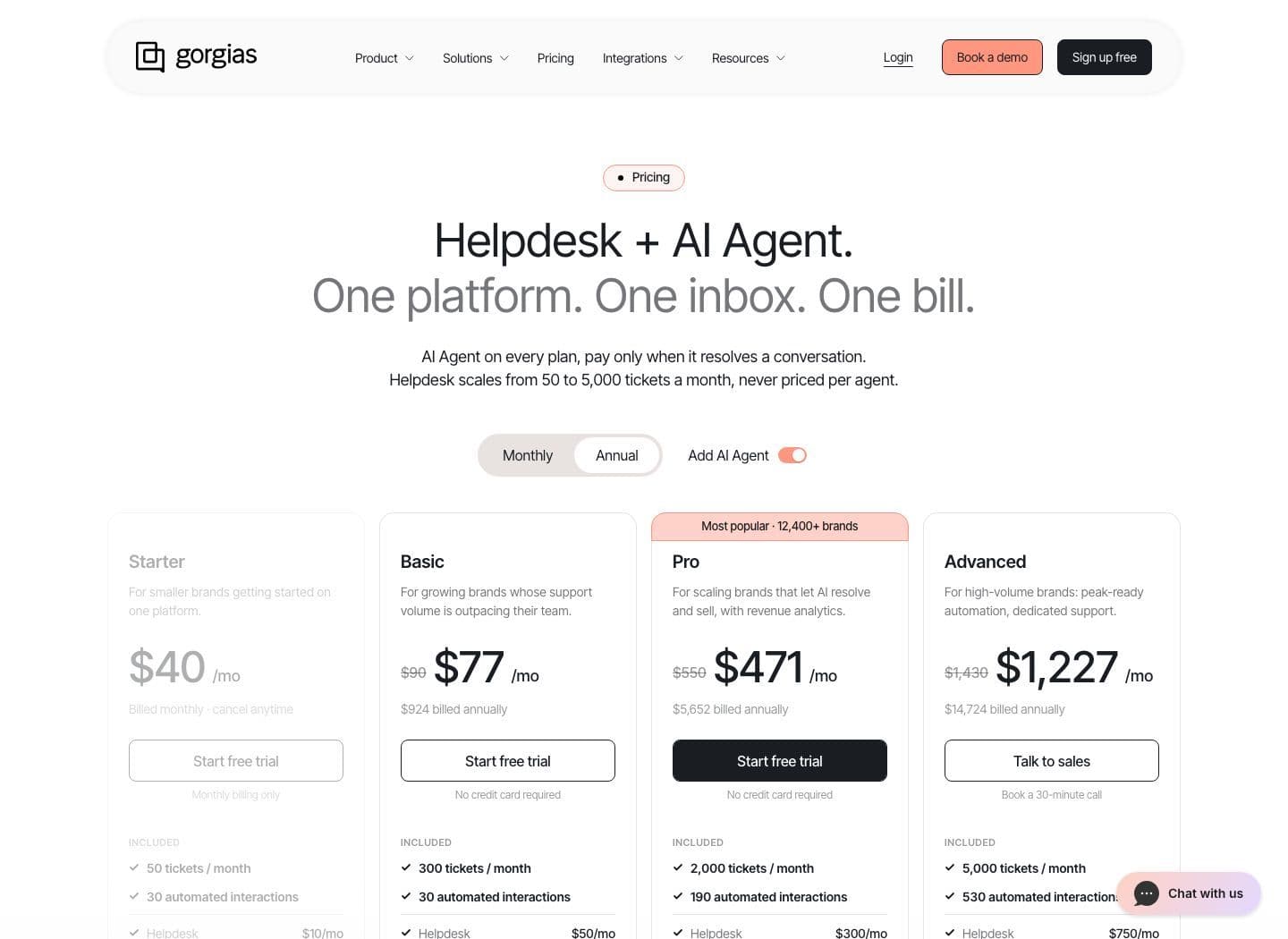
The chatbot job is service: answer where-is-my-order, handle sizing and returns questions, deflect the tickets a human never needed to touch, and hand off cleanly when one does. Done well it cuts support cost and response time, and the category anchor here is Gorgias, whose AI Agent advertises resolving 60 percent of routine inquiries instantly. Tidio is a common example; the Kinect vs Tidio breakdown shows where its support-first chatbot differs from a sales-first agent.
This job is bought by the support team, measured in deflection and resolution rates, and priced by ticket volume. It is real value, and for stores drowning in tickets it is the right first purchase.
60%
of routine inquiries Gorgias advertises as resolved instantly by its AI Agent
$40–$1,227
per month across Gorgias's published plans, sized by ticket volume, AI resolutions metered on top (gorgias.com/pricing, 15 Aug 2026)
2 jobs
hiding under one label: deflecting tickets and closing sales, measured on different P&L lines
Where the chatbot stops and the agent begins
A chatbot waits for questions. An agent sells: it greets the shopper, asks what they came for, narrows the catalog, recommends, handles the objection, and walks them to checkout, the way a good floor associate would. The distinction matters because the two jobs are measured against different lines on your P&L. Deflection saves cost. Selling makes revenue.
The full case for that distinction, with the demand data behind it, is in AI for ecommerce, and the sales-side job has its own page at AI sales rep.
The tools on each side of the line
Grouped by the job they are actually built for, with the head-to-heads where we have published one.
| Job | Tools | Where to compare |
|---|---|---|
| Support chatbot |  Gorgias, Gorgias,  Tidio, Tidio,  Siena, Siena,  Zowie Zowie | Gorgias alternatives, Kinect vs Tidio, Kinect vs Siena, Kinect vs Zowie |
| Selling agent |  Kinect, Kinect,  Rep AI, Rep AI,  Alhena Alhena | Kinect vs Rep AI, Kinect vs Alhena |
| Both, priced separately |  Zipchat and others straddle the line Zipchat and others straddle the line | Kinect vs Zipchat |
The two questions that cut through any demo
First, what does it measure against your own baseline? A deflection rate means nothing if ticket volume was falling anyway, and a conversion claim means nothing against a vendor benchmark. Ask what gets counted, and refuse benchmarks that are not your own store.
Second, how long to live? Chatbot deployments range from an afternoon to a quarter depending on how much workflow configuration the tool demands. A tool that misses your peak season cost you its first year of value before it answered a single shopper.
What Kinect does here, measured
Kinect is on the selling side of the line. It is an integration, not an app to configure for months, and it goes live the same day. Brands running Kinect see 3–6% more revenue against their own baselines, and 6–21% of shoppers who engage with it go on to purchase. What we count, and what we refuse to count, is public at how we measure.
Frequently asked questions
What is an AI chatbot for ecommerce
Software that answers shopper questions in a chat window, order status, sizing, returns, product questions, and deflects support tickets a human never needed to touch. It is a support tool, measured in deflection and resolution rates, and it is distinct from a selling agent that recommends and closes.
What is the difference between an ecommerce chatbot and an AI agent
A chatbot waits for questions and answers them. An agent sells: it greets the shopper, qualifies what they need, recommends products, and walks them to checkout. Deflection saves support cost; selling makes revenue. The two are measured against different lines on the P&L.
Which AI chatbot is best for ecommerce
For pure support, Gorgias anchors the Shopify DTC category with Tidio, Siena, and Zowie as the main alternatives. For selling, the field is Kinect, Rep AI, and Alhena. The honest answer depends on which job your store is hiring for, which is why our comparisons are organized by job.
How should chatbot results be measured
Against your own baseline, never a vendor benchmark. Support tools should show deflection and resolution on your ticket volume; selling tools should show revenue lift against your own store's history. Kinect publishes its counting rules at how-we-measure: 3–6% more revenue against the brand's own baselines, with 6–21% of engaged shoppers purchasing.
Related reading