9 min readGuide
AI shopping assistants that help shoppers choose and buy

By Kratik Agrawal
Published Aug 3, 2026 Updated Oct 13, 2026
An AI shopping assistant helps a shopper find, compare, and choose products through conversation. For a merchant, the selection question is whether that conversation can use accurate store information and help someone take the next buying step.
This guide separates shopper-side assistants from storefront integrations, explains the buying workflow, and shows how to evaluate recommendations, maintenance, and results.
Quick answer
An AI shopping assistant helps shoppers find, compare, and choose products. Check its product and policy sources, recommendation controls, purchase route, and fit with the team that maintains it.
Does a shopping assistant answer FAQs, recommend products, or both?
Check the buying job behind the interface. An assistant may answer questions, compare products, and guide a purchase. Support and selling capabilities can overlap. Use real catalog questions to verify sources, recommendation relevance, and how the assistant handles missing information.
Is it an AI FAQ, or is it more recommendation, or both?
Anonymous merchant buyer · 2026-05-18
In the selected merchant calls, 3 verified calls identify this requirement: shoppers need more than an interface label.
This excerpt comes from selected relevant merchant calls; its transcript wording was checked and lightly edited for readability, with the original retained internally.
Understand which shopping assistant you need
An AI shopping assistant does the job of a knowledgeable salesperson. It works out what a shopper wants, surfaces a few products that fit, and explains each pick. Vendors also call it an "AI-powered shopping assistant". Same tool.
The category has three homes. Platform assistants like ChatGPT, Perplexity, and Gemini recommend across the open web. Brand-side assistants live on a brand's own storefront and work from the brand's own data. Kinect builds the third kind, and this guide is mostly about it.
The good ones hold a real conversation. A shopper types "I'm going to a beach wedding" and the assistant reasons over the catalog the way a floor salesperson reasons over the stockroom.
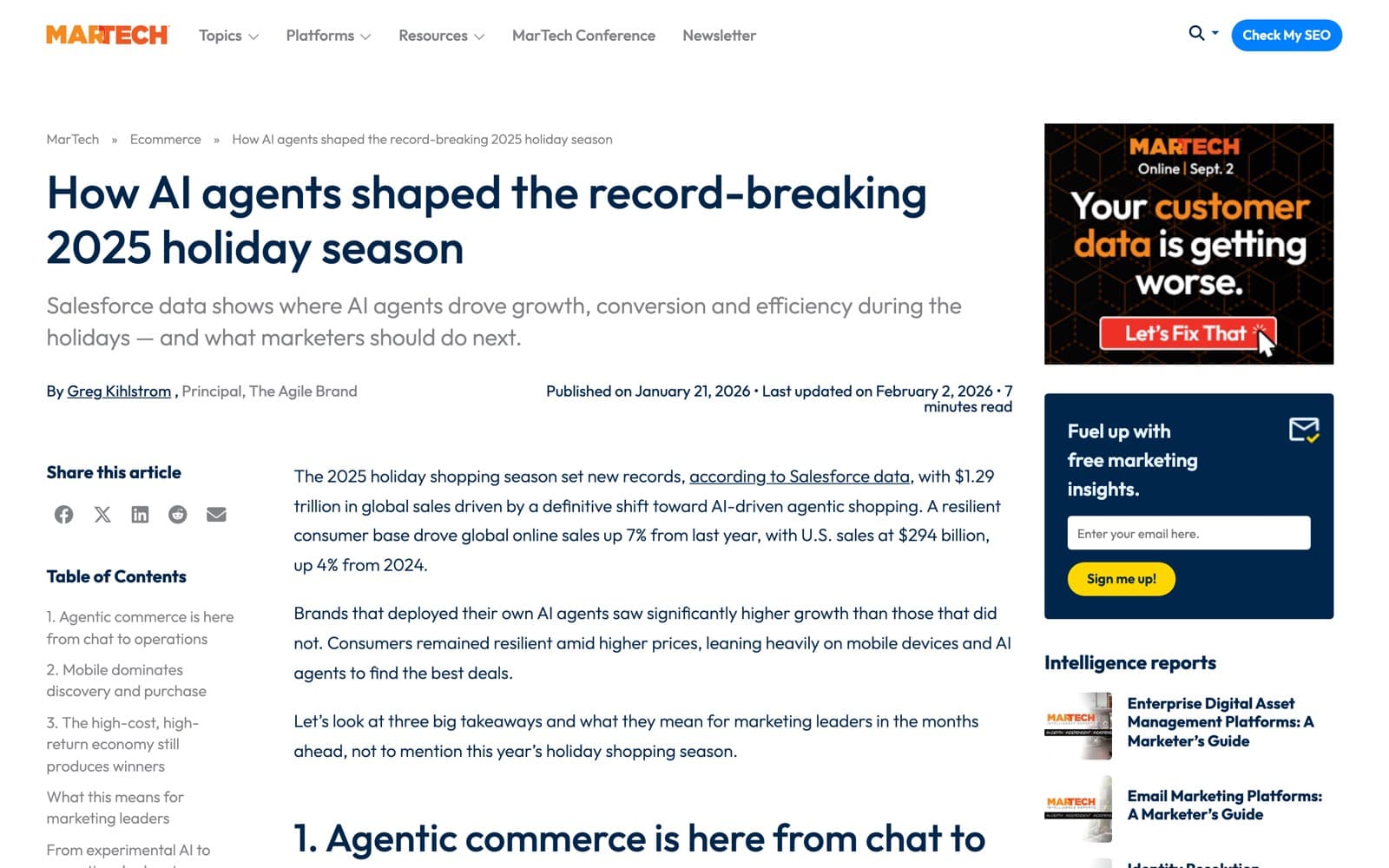
Buyer-side vs. brand-side. Split the category by allegiance before you split it by feature. Buyer-side assistants (ChatGPT, Perplexity, Rufus, and the shopping agents behind them) work for the shopper. They compare every store at once and describe your products from whatever data they can read, stale or current. You control none of that conversation. You only control how legible your store is to it. Brand-side assistants work for you. They live on your storefront, know your catalog and policies first-hand, answer in your voice, and keep the conversation and the customer relationship on your site. A shopper can arrive from a ChatGPT recommendation and still carry the questions that decide the purchase. Brands need an answer on both sides: readable to the buyer's agent, persuasive through their own. The 2025 holiday season put money on it. Salesforce counted $1.29 trillion in global online sales, with AI and agents influencing about 20% of it, roughly $262 billion. Brands that deployed their own agents grew 59% faster than brands that did not.
AI-referred retail traffic
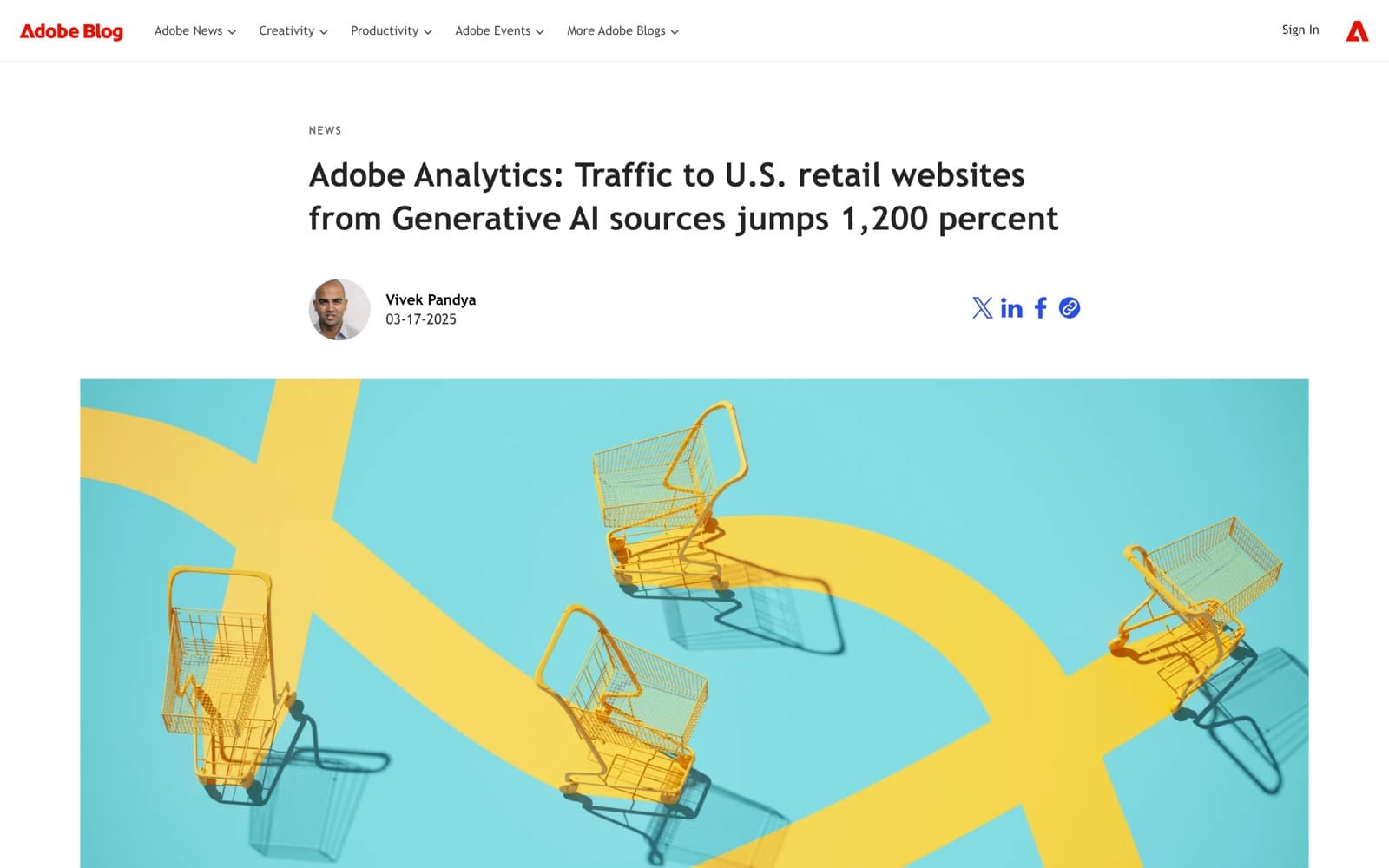
Adobe’s June 17, 2026 report describes traffic referred from AI sources to U.S. retail sites in May 2026. That cohort had a 54% higher conversion rate than non-AI referrals, spent 53% longer per visit, and viewed 23% more pages per visit.
These are observational comparisons between referral cohorts. They do not measure the incremental effect of adding an on-site assistant, and 54% higher conversion is 1.54 times the comparison rate.
Adoption is still early. YouGov found 43% of Americans aware of AI shopping assistants, 14% having used one (24% among Gen Z), and 41% saying they distrust them. The reported trust gap is a reason to explain recommendations and handle uncertainty accurately.
AI-referred retail visitors and shoppers who engage an on-site assistant are different cohorts. Keep referral-source observations separate from an experiment measuring your store’s assistant.
What this comparison measures
What merchants need a shopping assistant to handle
The selected merchant conversations below identify requirements to test. Each count is a minimum observed set of verified calls, not an estimate of how common the requirement is across stores.
| Observed buyer requirement | Minimum source calls | What to verify |
|---|---|---|
| Shoppers need more than an interface label | 3 | Compare FAQs, product explanation, and context-specific advice using real buyer questions. |
| Recommendations must react to the shopper and merchant constraints | 3 | Test rejected choices, product pairings, and missing product facts. |
| Buying advice needs a workable service boundary | 2 | Keep support coexistence and sales handoff clear without forcing a helpdesk migration. |
Follow the buying workflow and read the results
Early shopping bots wrapped keyword search in a chat window and failed. The assistants that sell share six behaviors:
AI shopping assistant vs. chatbot vs. site search. An AI shopping assistant is defined by its buying job, while a chatbot is an interface that may provide support, product advice, or both. Capabilities overlap, so evaluate the actual question, data, and next action instead of using the label as a verdict. Current Gorgias and Tidio materials include product-recommendation capabilities. Kinect focuses on sales and broader revenue jobs. A store may still need a helpdesk alongside that sales-focused integration. Compare ecommerce chat workflows and the Shopify assistant shortlist.
What to look for before you put one on your store. The demos all look the same. These questions separate the vendors:
What results actually look like. An on-site assistant's numbers describe the shoppers who choose to engage with it, and engaged shoppers are a high-intent cohort. Treat store-wide causal lift claims with suspicion, including ours. We publish how we measure for that reason. Where Kinect fits. The AI Sales Rep, our shopping assistant, is revenue job #1 of one intelligence trained on your catalog, policies, customers, and conversations. The same intelligence adapts your product pages, enriches your catalog for ChatGPT and Google, and keeps your storefront readable to buyer-side agents. It runs as an integration on your existing storefront and goes live the same day, in your brand's voice. Book a demo and we'll show you what it would say to your shoppers, on your own catalog. Separate the shopper’s assistant from the brand’s assistant. A consumer may ask a general assistant what to buy across many stores. Both can support discovery, but the context and responsibilities differ. The original catalog comparison below makes this distinction concrete without claiming that one interface automatically earns distribution in an external AI answer.
- Trained on the store. Catalog, variants, live availability, shipping and returns policies. First-hand data means it recommends what's in stock and quotes policies as written.
- Asks before it recommends. One or two clarifying questions when intent is ambiguous. Then it commits.
- Scores fit, not keyword match. "Warm enough for fall hiking" should surface the right jacket even when no product title says so.
- Explains each pick. Shoppers trust a recommendation with a because attached. So do the AI assistants deciding whether to cite you.
- Admits when nothing fits. A forced recommendation burns trust for the next sale.
- Closes. It compares options, handles the objection, and moves the shopper to checkout.
- Where product knowledge comes from. Live catalog sync or a snapshot that goes stale. Ask what happens when a product sells out mid-conversation.
- Voice control. Shoppers notice when the assistant sounds like a call center.
- How lift is measured. Engaged shoppers were always going to convert better. Ask for the methodology before the metric.
- Who keeps the data. Conversations are customer research. An assistant that keeps them does free discovery for someone else's roadmap.
- Setup time. An integration on your existing storefront should be live the same day.
- Buyer-side reach. The same catalog understanding that answers your shoppers can feed ChatGPT and Google the right facts about your products.
Run your numbers
Your store, through the published engaged-cohort range. Adjust any field.
2,500
shoppers engage with the assistant each month
50 orders
if that cohort converted at your site average ($4,250/mo)
150–525 orders
at the published 6–21% engaged range ($12,750–$44,625/mo)
Read this honestly: the gap describes the engaged cohort, not store-wide causal lift. Shoppers with questions self-select into that cohort, and they were always likelier to buy. The number worth trusting comes from measuring against your own baseline, the way we measure.
Behind that sits one intelligence per brand, trained on the catalog, policies, customers, and conversations. Kinect's platform is built on that architecture.
Support resolution and pre-purchase advice are different buying jobs, but modern tools can support both. Current Gorgias and Tidio documentation includes product recommendations. Evaluate accuracy, controls, purchase actions, and service handoff using your own questions rather than assuming a vendor category determines depth. Compare ecommerce chat workflows.
We keep a ranked comparison of the twelve leading tools, including where each beats us, in the best AI shopping assistants for Shopify guide.
The pattern repeats across stores: the assistant catches the shopper at the moment a question would otherwise become a closed tab. The case studies show what that looks like per store.
Start with one buying problem, maintain the product and policy sources, and agree on the comparison, traffic scope, and measurement window. Evaluate against your own baseline without promising a result or a universal reporting deadline.
Choose a measurable pilot
Match the assistant to a real buying decision
Useful questions concern fit, compatibility, ingredient preferences, gift choice, delivery, or comparisons between two items. Do not reduce the evaluation to whether its greeting sounds human. The best-assistant comparison helps choose a shortlist based on the job.
Published source context for the comparison. Source review checked October 13, 2026. Shopify catalog interfaces.
| Observed source item | Source fact or scope | Buying implication |
|---|---|---|
| Global Catalog | Across eligible Shopify merchants | Cross-brand discovery and comparison |
| Storefront Catalog | One merchant’s store | Advice grounded in that store’s products |
Work through the numbers before testing
Illustrative engaged-cohort versus store-wide measurement. 100 ÷ 1,000 = 10% engaged-cohort conversion; (100 + 180) ÷ 10,000 = 2.8% store conversion. This comparison alone does not prove causal lift.
| Illustrative input | Assumed value |
|---|---|
| Store sessions | 10000 |
| Engaged sessions | 1000 |
| Engaged purchase sessions | 100 |
| Other purchase sessions | 180 |
Build a maintained pilot with a clear outcome
An assistant needs accurate descriptions, variants, availability, and policies. Check where those facts come from, how changes reach the assistant, and what happens when a fact is absent. A fluent unsupported answer can mislead a shopper. Our Shopify chatbot guide turns catalog and policy grounding into practical setup questions for a Shopify store.
Expect support and selling to overlap. Modern support vendors can also recommend products. A chatbot is a conversation interface, not proof the system is limited to FAQs. A store that needs ticket routing may need a helpdesk; a store that needs better pre-purchase advice may prioritize a sales-focused integration. Those tools can coexist.
Review recommendations as a merchant. Test an out-of-stock item, an excluded product, a changed price, and a shopper request that has no suitable match. Look for controlled escalation and an honest admission when the assistant lacks information. Require a real product answer rather than accepting a generic buying suggestion with your store’s logo above it.
Measure outcomes without turning engagement into a guarantee. Separate engaged-cohort behavior from all-store outcomes, keep denominators explicit, and use a suitable comparison before claiming incrementality. Kinect publishes its measurement approach. Its AI Rep focuses on helping shoppers choose and buy as one revenue job within the platform. Run a recommendation case with a real constraint. Use a request with a fit, compatibility, budget, or delivery constraint. Write expected products and sources. Check follow-up questions and the purchase route. Explain when no product meets the request. Ask who maintains the merchant knowledge. Identify the owner and update path for each product fact, variant, exclusion, and seasonal policy. Involve that operator in the demo and repair the source when an answer fails.
Choose a pilot that can answer a commercial question. Choose a product family with a known buying question, reliable sources, and a measurable route. Set eligibility, recommendation limits, and escalation. Review answer quality and purchasing results separately. Keep the assistant from becoming another competing destination. Check proactive messages, overlapping widgets, links, and mobile placement. Match help to the decision: a shopper choosing an item may need advice; someone already buying may need one clarification. Keep the store usable without chat. Compare the data route before the brand promise. Ask where answers come from, how availability updates, and what happens when a fact is missing. Verify permissions and purchase actions. Catalog access still needs merchant controls and outcome measurement.
Choose the next step
Choose the first buying question the assistant must answer well. Take that question, its catalog source, and the expected next step into a demo. Commit to a pilot only when someone owns answer maintenance and the outcome definition.
Frequently asked questions
What is an AI-powered shopping assistant?
The same thing as an AI shopping assistant: conversational AI that helps shoppers find, compare, and choose products. "AI-powered" is a phrasing habit. The split that matters is buyer-side (ChatGPT, Rufus, shopping for the customer) versus brand-side (on your storefront, selling for you). External discovery and on-site help serve different tasks. An on-site assistant can help with those questions, while maintained, readable catalog content supports accurate product information. Neither guarantees what an external assistant will say.
What's the difference between an AI shopping assistant and a chatbot?
A shopping assistant is defined by helping shoppers find, compare, and choose products. A chatbot is a conversational interface that may handle support, product advice, or both. Evaluate the actual workflow, answer sources, controls, and next action.
What's the best AI shopping assistant for Shopify?
Choose on the buying job, catalog questions, and operator workflow. Our twelve-tool comparison uses current official documentation and explains what to verify in a demo; it is not an independently measured performance ranking.
How much does an AI shopping assistant cost?
Book a demo with Kinect to discuss your store and get a direct answer.
How long does it take to set up?
For Kinect: same day. It runs as an integration on your existing storefront. The intelligence trains on your catalog and policies, and the assistant goes live without a theme rebuild.
Related reading