5 min readGuide
ChatGPT Merchants, explained

By Kratik Agrawal
Published Aug 4, 2026 Updated Aug 4, 2026
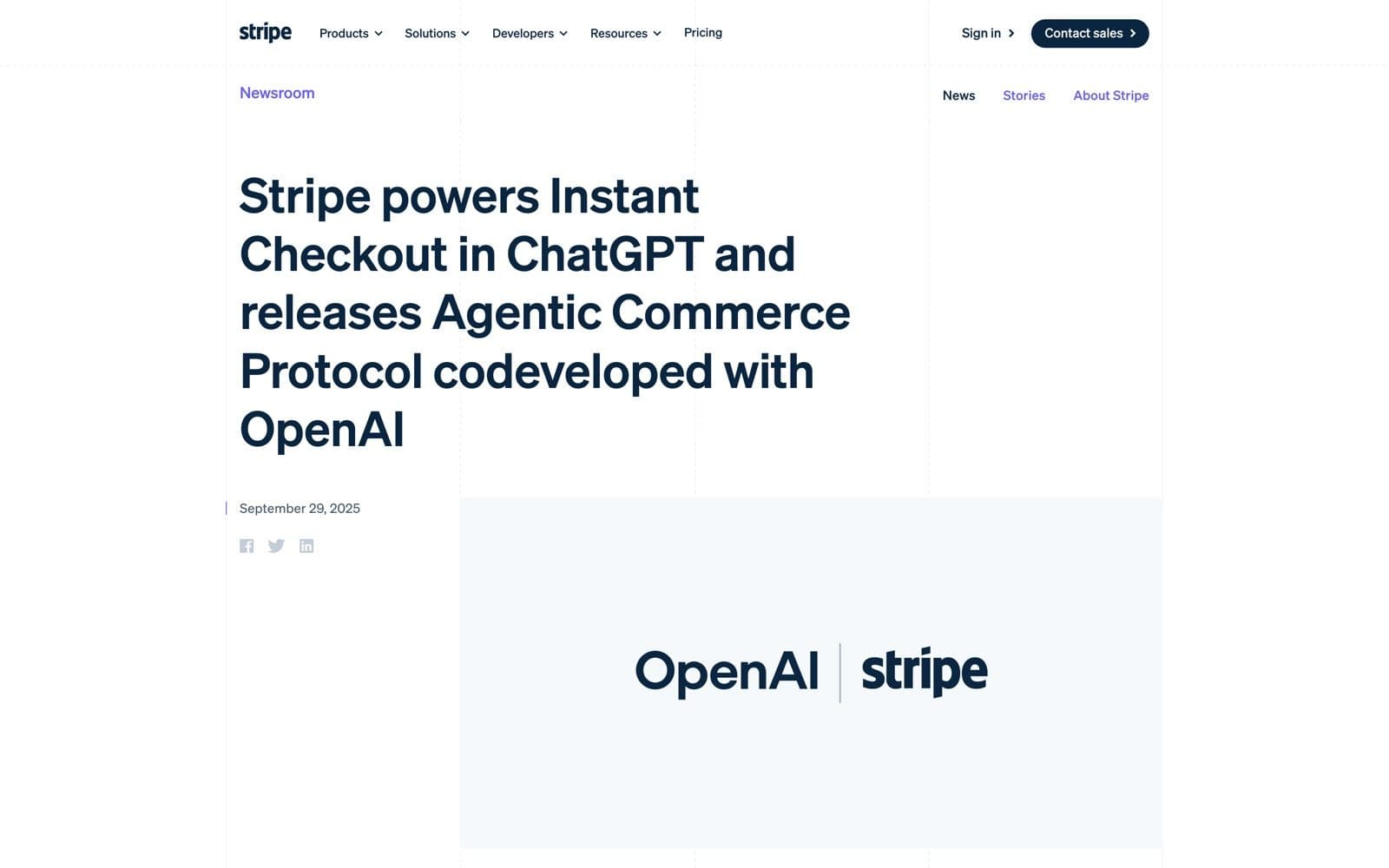
On September 29, 2025, OpenAI launched Instant Checkout and opened chatgpt.com/merchants. The idea is simple: hand ChatGPT your product data and it stops guessing about your brand from a scrape. Shoppers can even buy inside the chat.
This guide covers how the program works, what the feed requires field by field, and what to fix in your catalog before you connect.
Quick answer
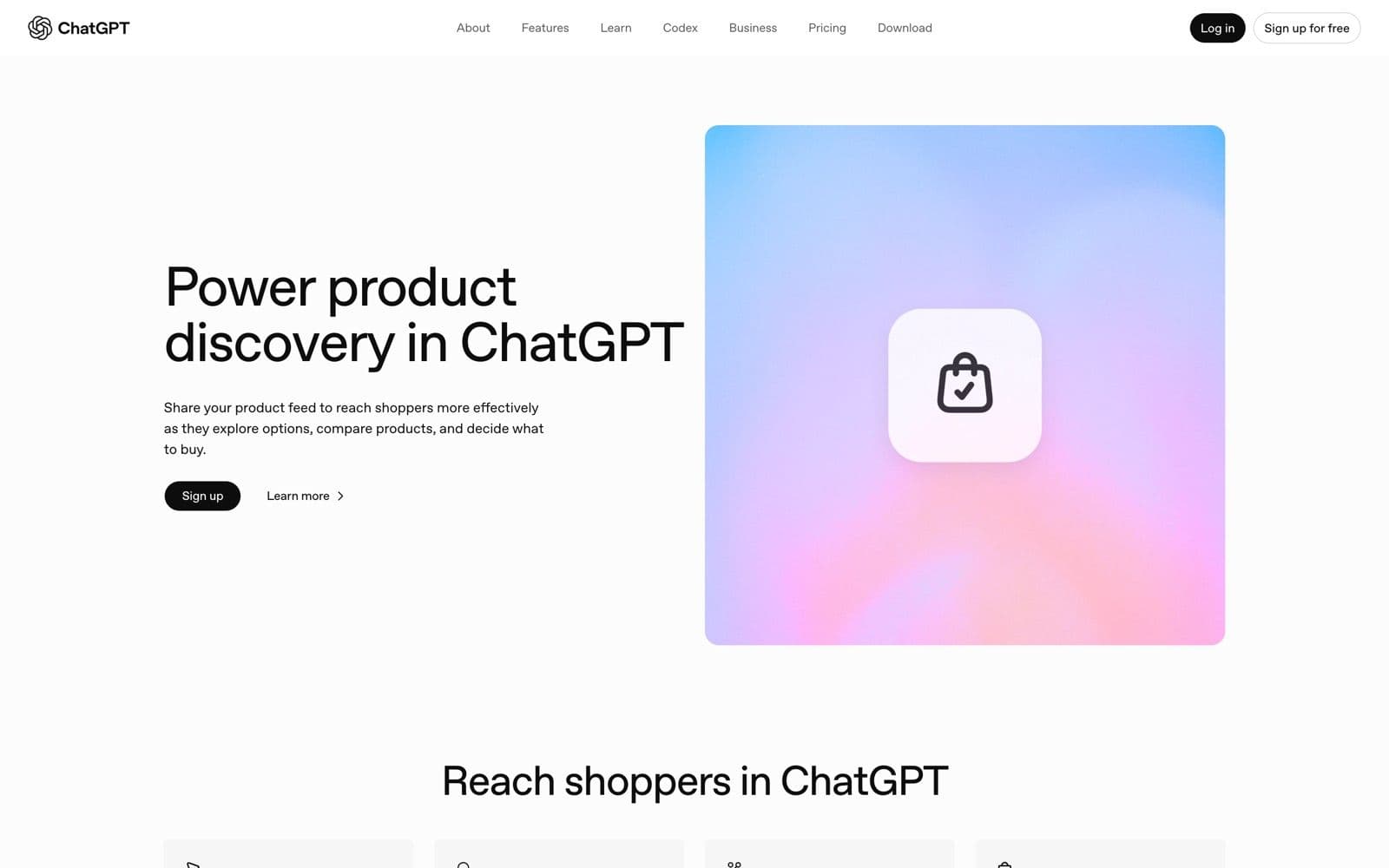
ChatGPT Merchants is OpenAI's program for getting product catalogs into ChatGPT. You share a product feed at chatgpt.com/merchants, and ChatGPT shows your products with live price, stock, and images when shoppers ask what to buy. Feed-connected products can support Instant Checkout, where the purchase happens in the chat and you stay the merchant of record. Shopify and Etsy connect through platform integrations; everyone else joins a waitlist.
What ChatGPT Merchants actually is
A merchant applies at chatgpt.com/merchants, shares a product feed, and ChatGPT indexes it for shopping answers. When a shopper types "waterproof trail shoes under $150", the products it shows can come from connected feeds, current price and stock included.
There are two layers. Discovery: your feed powers what ChatGPT shows. Checkout: the shopper buys inside the conversation, and the order reaches your backend over the Agentic Commerce Protocol, the open standard OpenAI built with Stripe. You accept or decline the order, charge the payment, ship it, and own the customer relationship. ChatGPT is the middleman, and you stay the merchant of record.
For brands without a feed, ChatGPT still recommends products. It just works from whatever public pages it has read, which is the slower game covered in how ChatGPT picks products.
Who gets in, and how
Shopify and Etsy merchants ride in on platform integrations, controlled from their store settings. Shopify's agentic commerce launches keep widening that lane.
Everyone else fills out the form: company details, website, product categories, rough SKU count. Approved merchants get feed onboarding instructions. OpenAI hasn't published review timelines, and seller reports are mixed. Some saw product traffic soon after connecting, others describe a queue that opens category by category. Once you are in, the file becomes something you maintain rather than something you ship once, which is product feed management.
Apply anyway. The form takes a few minutes, and when your category opens, the merchants already in the queue show up first.
What the product feed requires
OpenAI publishes the spec at developers.openai.com/commerce. The file-upload path takes UTF-8 TSV or CSV, plain or gzipped, one product or variant per row. If you already run a Google Shopping feed, OpenAI accepts Google-compatible formats without renaming columns.
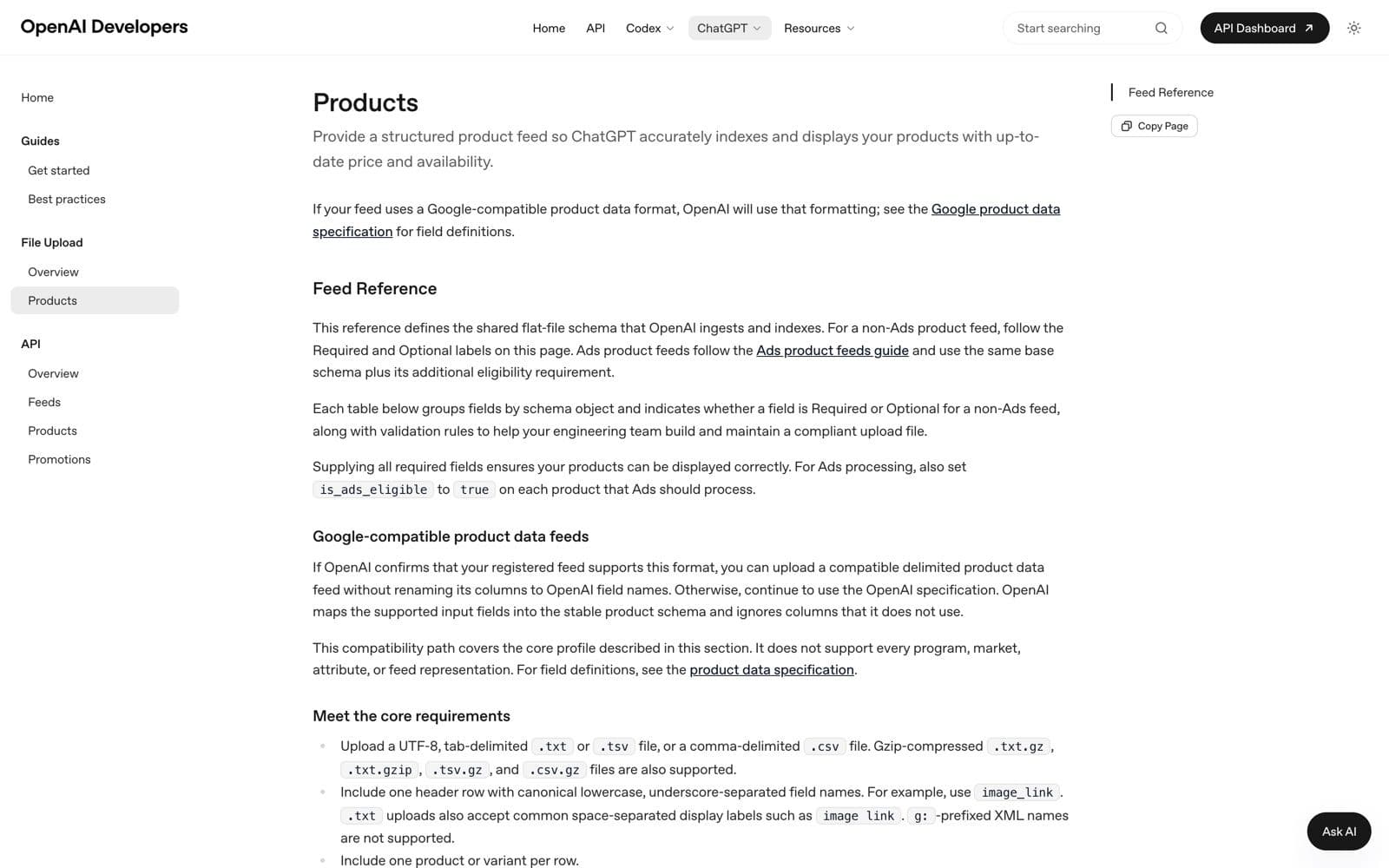
| Field | What it is | Required |
|---|---|---|
| item_id | Your product ID, unique per variant | Yes |
| title / description | Product title and full description | Yes |
| url | Product detail page URL | Yes |
| image_url | Main product image URL | Yes |
| brand | Product brand | Yes |
| price | Price with currency | Yes |
| availability | Stock status | Yes |
| store_country / target_countries | Where you sell from and to | Yes |
| is_eligible_search | Shows the product in ChatGPT results | Yes |
| is_eligible_checkout | Turns on in-chat purchase (needs search on) | Yes |
| seller_name / seller_url | Who is selling, linked in results | Yes |
| seller_privacy_policy / seller_tos | Policy pages shown at checkout | Checkout only |
The two flags are the levers. A product can be searchable without being buyable in-chat, so brands can join discovery first and turn on checkout when the order flow is ready.
And the description field does the selling. ChatGPT reasons over it when it decides whether your product answers the question. A title, a color, and a price give it nothing to work with.
The takeaway
The feed is the difference between ChatGPT guessing about your products and quoting your data. You control the second. The first happens to you.
How products get picked
OpenAI says results are organic and relevance-based, the fee doesn't buy placement, and shoppers pay nothing extra. Connected data still wins on presence: Profound looked at roughly 1 million ChatGPT shopping sessions and found that when a product came from a direct feed, it was the first offer shown 99.9% of the time.
No feed means you're competing for citations from public pages, and our playbook for getting recommended by ChatGPT covers that game. Paid placement is separate: in May 2026 OpenAI added product feed campaigns to its Ads Manager, and our early read on ChatGPT ads covers when that spend makes sense.
99.9%
of the time, a feed-connected product was the first offer shown, in Profound's study of ~1M ChatGPT shopping sessions
$0
to list. OpenAI charges a fee on completed Instant Checkout purchases only
Sep 29, 2025
Instant Checkout and the merchant portal launch
What to fix before you submit
The feed exports your catalog as it actually is. Thin data reads fine on your own product pages, where photos and reviews carry the load. In a text conversation it disqualifies you. Work through the catalog first: The field-by-field version of that cleanup is product feed optimization.
- Descriptions that answer questions. Fit, fabric, sizing, use cases. ChatGPT recommends products it can defend to the shopper.
- Variants as real rows. item_id is unique per variant. Sizes buried in an options string leave ChatGPT unable to say whether the medium is in stock.
- Availability that updates. A feed that says in stock when you sold out last week sends a shopper to a dead page. The next answer may skip you.
- A store agents can read. The feed covers products. The assistants shopping for your customers also read your pages and policies, which is the agent-ready storefront problem.
Where Kinect fits
The whole goal is to help your brand make more money from AI shopping, on both sides of it. Kinect is one intelligence per brand, trained on your catalog, policies, customers, and conversations. Catalog Enrichment is the job that matters here: it cleans up and fills in your catalog, fit, fabric, occasion, pairings, then distributes it to ChatGPT, Google, and the surfaces where AI shops. So when you show up, you show up right.
It runs as an integration on your existing storefront and goes live the same day. Book a demo and we'll pull up what ChatGPT currently says about your products, on the call.
Frequently asked questions
What is ChatGPT Merchants?
OpenAI's program for listing products inside ChatGPT. You apply at chatgpt.com/merchants and share a structured product feed. ChatGPT uses it to show accurate prices, stock, and images in shopping answers, and feed-connected products can support Instant Checkout, where the purchase completes in the chat.
How do I get my products to show up in ChatGPT?
Connect a feed at chatgpt.com/merchants, or participate through your platform if you sell on Shopify or Etsy. Without a feed, ChatGPT describes your products from public pages it has read, so your product pages, reviews, and third-party coverage decide how you appear.
Do Shopify stores need to apply to ChatGPT Merchants?
Generally no for discovery. Shopify catalogs reach ChatGPT through the platform's own integration, controlled from your store settings. The merchant portal is still worth a look for direct feed control and checkout options as the program expands.
What fields does the ChatGPT product feed require?
Per OpenAI's spec: item_id (unique per variant), title, description, brand, url, image_url, price, availability, store_country and target_countries, seller_name and seller_url, plus the is_eligible_search and is_eligible_checkout flags. Checkout products also need seller_privacy_policy and seller_tos. UTF-8 TSV or CSV, and Google-compatible feeds are accepted.
Does it cost anything to be listed in ChatGPT?
No. Listing is free, results are organic and relevance-based, and merchants pay a fee only on completed Instant Checkout purchases. OpenAI says the fee doesn't affect prices or influence results. Sponsored product feed campaigns exist separately in its Ads Manager.
Can shoppers buy without leaving ChatGPT?
Yes, on products with is_eligible_checkout on. The shopper pays with saved methods in the chat, the order reaches you over the Agentic Commerce Protocol, and you accept or decline it, charge the payment, and handle fulfillment as the merchant of record.
Related reading
- How ChatGPT Shopping Actually Picks Products
- How to Get Your Brand Recommended by ChatGPT: A Working Playbook
- ChatGPT Instant Checkout for Shopify Brands: What It Is and How to Get In
- The Agentic Commerce Protocol, Explained
- Product feed management in 2026
- Product feed optimization in 2026
- AI agents for ecommerce: a buyer’s guide